Rains in southwest U.S., dryness in Northern Plains: NOAA
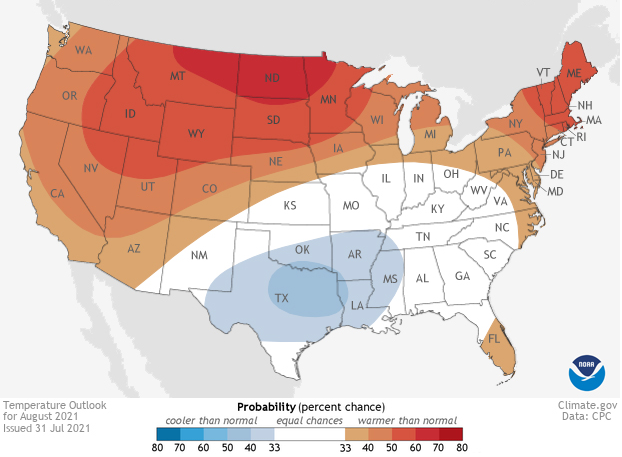
Probability of a cooler or warmer than average August. (Photo credit: NOAA)
NOAA – As the calendar shifts to the dog days of summer, many of us are wondering whether the summer will end as it began. The August 2021 outlook from the National Oceanic and Atmospheric Administration’s (NOAA) Climate Prediction Center looks to answer that. For some, especially those in the Southwest, the August outlook predicts a continued wet recovery after a year of dryness. For others, like those across the northern tier of the United States, the story of the August outlook is more hot and dry conditions.
Hotter-than-average end to summer for much of the country outside the south-central United States
If the August temperature outlook looks familiar, that’s because you are remembering what the July temperature outlook looked like. The two temperature outlooks look remarkably similar for much of the country. Expected hotter-than-average temperatures continue to be the summer story as the outlook favors heat for the western and northern United States. The highest likelihood for above-average temperatures (60 to 70 per cent) is located across the dry northern Plains in Montana, North Dakota, and western Minnesota as low soil moisture due to dry conditions is enhancing the chance for hot temperatures.
In contrast, the soggy south-central U.S. in Texas and the Gulf Coast is the one area in the country favored to observe a cooler-than-average August. Not only are the climate models used by forecasters at the Climate Prediction Center hinting at this outcome but the wet conditions and high soil moisture values across the region are expected to act to cool temperatures.
Speaking of wet conditions…
August could be a wet one
A broad area across the Southeast, Mid-Atlantic, and Southwest is favored to observe a wetter-than-average August. For the Southeast, the forecast for the beginning of August is a wet one. And even though things are not expected to be nearly as wet in the region for the rest of the month, the sheer amount of rain that could fall during the first week helps to tilt odds to a wetter-than-average month. The highest likelihood for an above-average month of precipitation is across the eastern Carolinas, where total rainfall might exceed five inches during the first week of the month.
Meanwhile, a wetter-than-average outlook for the Southwest reflects the expectation that the North American monsoon, after a brief lull during early August, will roar during the rest of the month. As covered recently, the 2021 North American monsoon through July has been among the wettest on record for parts of Arizona. The heavy rain has caused flash flooding across the state, and has replenished groundwater in many areas, helping to reduce the severity of drought. Continued rains will alleviate the worst of the drought, but long-term drought will remain a concern.
In contrast, odds favor a drier-than-average August extend across the Northern Plains. Bad news for a region of the country where severe drought conditions are extensive.
Drought improves in the Southwest, worsens across the Northern Plains
At first glance, the drought across the West looks as bad as ever, but if we take a deeper look at the margins there is actually some good news across the water-starved Southwest. During the middle of July in Arizona, over 57 percent of the state was in D4-Exceptional Drought, the worst category. Just two weeks later, less than nine per cent of the state is mired in D4 drought, a drastic improvement. But while the areas suffering under the worst drought have decreased, the amount of Arizona still in any level of drought remains unchanged.
The bigger picture, though, remains poor out West as 95 per cent of the region is in drought with nearly 25 per cent in D4 drought.
For the next month, much of the western drought is likely to remain and even expand across the central Plains in Nebraska and Iowa. However, in good news, drought improvement is likely across the Southwest in Arizona and New Mexico after August.