
Canada’s nitrogen footprint shows great regional variation
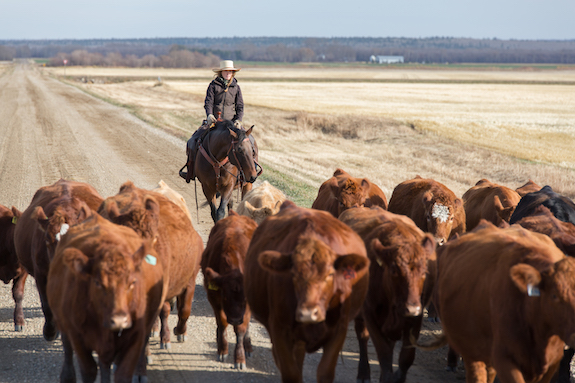
cattle drive down a dirt road
McGill – Reactive nitrogen emissions contribute to greenhouse gases, as well as air and water pollution. Researchers from McGill University have calculated Canada’s nitrogen footprint (akin to a carbon footprint) – at both national and provincial levels – for the first time. The three primary sectors that contribute nitrogen to the environment to calculate the annual average nitrogen footprint were looked at: food production and consumption, wastewater treatment, and fossil fuel use. There were some regional surprises when they analyzed their results.
“Past nitrogen footprint studies in other countries have typically emphasized the food system as the main source of nitrogen released to the environment,” said Graham MacDonald, an Associate Professor in McGill’s Geography Department and the senior author on the paper published recently in Environmental Research Letters. “While food production and consumption are important sources of nitrogen in Canada, our research shows that most variation across provinces in a relative sense is related to fossil fuels. This came as a surprise to some of our colleagues.”
The researchers used a novel top-down approach, which took national and provincial agricultural, energy and other nitrogen emissions data from 2018 to estimate total provincial nitrogen footprints and divided them by provincial populations. Typically, assessments of nitrogen footprints are estimated using a bottom-up approach based on information about personal consumption patterns (e.g. household use of electricity, distances driven or flown, beef consumption, etc.). Using this new hybrid approach, the researchers calculate that Canada’s total annual reactive nitrogen footprint is approximately 996 gigagrams (or 996 billion kilograms) per year. This translates into an average nitrogen footprint of about 27 kilograms of nitrogen emitted per person per year in Canada. But this figure hides a lot of regional variation, both in terms of the magnitude and the drivers responsible for these emissions.
“Ontario and Quebec contribute the most to the national nitrogen footprint simply because more than two-thirds of the Canadian population live in these provinces,” says Sibeal McCourt, a PhD student in the Geography Department at McGill and first author on the study. “But Saskatchewan’s nitrogen footprint, on a per capita basis, is the largest in the country, almost double that of Ontario. This is because the province has a strong mining sector and relies on coal and natural gas for energy.”
Moving towards using nitrogen more efficiently
“Before we can reduce our overall national nitrogen footprint, it is essential to understand which sectors in each province are contributing the most to nitrogen pollution so that the problem can be addressed at a more local levels,” added McCourt. “This research will help us better understand the where/who/how of actions to reduce nitrogen emissions, assign responsibility to different actors (including our own consumption patterns, like our personal diets), and ultimately use nitrogen more efficiently in Canada.”
Given the relative contribution of meat consumption and fossil-fuel related emissions to provincial nitrogen footprints, the researchers suggest that moving towards more plant-based diets, promoting the use of electric vehicles and continuing to shift towards renewable energy sources for electricity where possible are among the policy options that would be most relevant across much of the country. Steps can also be taken to make the food system as a whole less ‘leaky’ in terms of nitrogen.
“A great deal of research attention is being given to improving nitrogen use efficiency in agriculture, which can go a long way toward mitigating the Canadian nitrogen footprint,” says MacDonald. “What’s particularly insightful about a footprint approach is that it allows us compare the potential of these different individual and collective efforts toward sustainability.”
Some details about variations in provincial nitrogen footprints
The researchers analyzed the three primary sectors that contribute to provincial nitrogen footprints: 1) food production and consumption, 2) wastewater treatment, 3) fossil fuels
Food production and consumption
In all provinces 35 to 40 per cent of nitrogen footprints come from beef consumption.
In Ontario, New Brunswick and Quebec, beef consumption is the single largest overall driver of the provincial nitrogen footprint and the second largest driver in all other provinces apart from Alberta and Saskatchewan.
Apart from Ontario and Quebec, in all other provinces less than 50 per cent of the nitrogen footprint comes from food production.
Differences in types of crops grown and farm management techniques affect the portion of provincial nitrogen footprints related to farming.
Wastewater treatment
Wastewater treatment is the 3rd largest driver of national and most provincial footprints, since there are relatively low levels of nitrogen removal in wastewater treatments across the country.
Only approximately 30% of Canada’s population is connected to municipal wastewater systems that receive treatments that focus on removing nitrogen.
Coastal provinces (British Columbia, Nova Scotia, New Brunswick, Prince Edward Island, Newfoundland and Labrador) with relatively low population densities, and which discharge primarily to coastal waters, have generally lower effluent standards (and nitrogen removal) than interior provinces (Ontario, Manitoba, Saskatchewan and Alberta).
Alberta is the province with the largest proportion of its population covered by wastewater treatment, which also focuses explicitly on nitrogen removal.
In British Columbia only 10 per cent of the population is covered by this kind of wastewater treatment and it is also the province with the largest wastewater nitrogen footprint.
Fossil fuels
Burning fossil fuels account for 40 per cent of the average Canadian nitrogen footprint, but nitrogen footprints related to fossil fuels vary considerably by province.
Nitrogen emissions related to transport are the largest portion of the fossil fuel nitrogen footprint.
Heavy-duty diesel vehicles, typically associated with trucking, mining and other resource extraction activities, are a major contributor to transport emissions.
In Nova Scotia, Saskatchewan and Alberta relatively high proportions of the energy grids are powered by burning coal. The 3 provinces have a combined average energy nitrogen footprint of almost seven kilograms of nitrogen per person.
In other provinces which rely on renewables and nuclear energy, the average nitrogen footprint related to energy is about 1.5 kg per person.
(The three northern territories were excluded from the study due to limited data.)