
Too dry, too hot, or too wet: Increasing weather persistence in European summer
Study analyses 2010 heat wave, 2018 dry summer
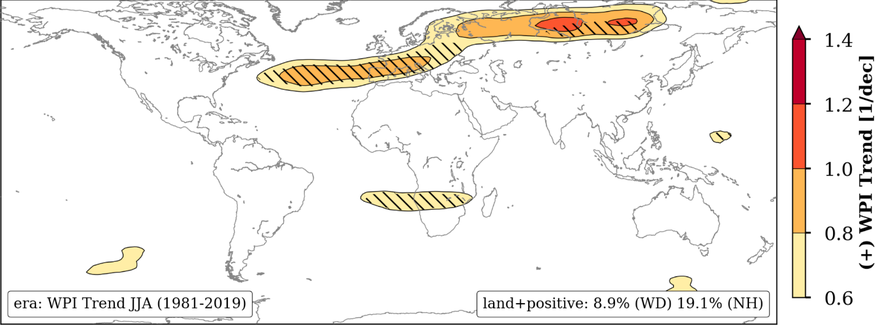
Regions of the world where an increase in persistent weather conditions is observed in summer (Jun-Aug). Photo: PIK Potsdam.
Potsdam Institute for Climate Impact Research (PIK) – To prove prolonged sunny or rain conditions lead to extreme events, scientists from the Potsdam Institute for Climate Impact Research (PIK) analyzed the persistence of specific weather conditions. They applied established image comparison methods on atmospheric data, comparing millions of successive weather circulation patterns worldwide over the last 40 years. They especially looked at two individual extreme events: the 2010 heat wave over Russia and the extraordinary dry summer over Europe in 2018.
“We found that weather patterns in general are more persistent now than some decades ago,” said Peter Hoffmann of the PIK and lead author of the study. “Especially in summer, heat waves often last longer now, and also rainfall events tend to linger longer and to be more intense. The longer these weather conditions last, the more intense the extremes can become, both on the warm and dry side as well as on the steady rain side.”
The rise in persistent weather conditions is to a large extent due to dynamical changes in the atmosphere as the westerly winds tend to stop pushing forward weather systems, which become more persistent, turning some sunny days into heatwaves of several weeks, as well as intensive rainfall into floods.
Like the eye of a knowledgeable observer, the new image comparison method systematically scans atmospheric fields and helps to assess to which extent successive weather circulation patterns change over time or remain stable. Fred Hattermann, co-author of the study and also scientist at PIK, explained the potential of the new approach.
“Our method crucially improves the interpretation of long-term climate impacts. When applying the same methodology to climate model output, we do not see a comparable increase in weather persistence, especially not over Europe. Climate models may have been a bit too conservative, underestimating the rise in weather persistence, thus underestimating weather extremes over Europe,” he said.
This becomes ever more important with ongoing climate change.
“Recent events and ongoing research have shown that the number and intensity of extreme events have increased due to the global rise in temperature,” concluded Hattermann. “To counteract this worrying trend, the goal has to be to reduce global greenhouse gas emissions and by doing so limit climate change.”