
Volcano triggers tsunami warnings, but won’t affect global climate
Not enough SO2 thrown into atomosphere
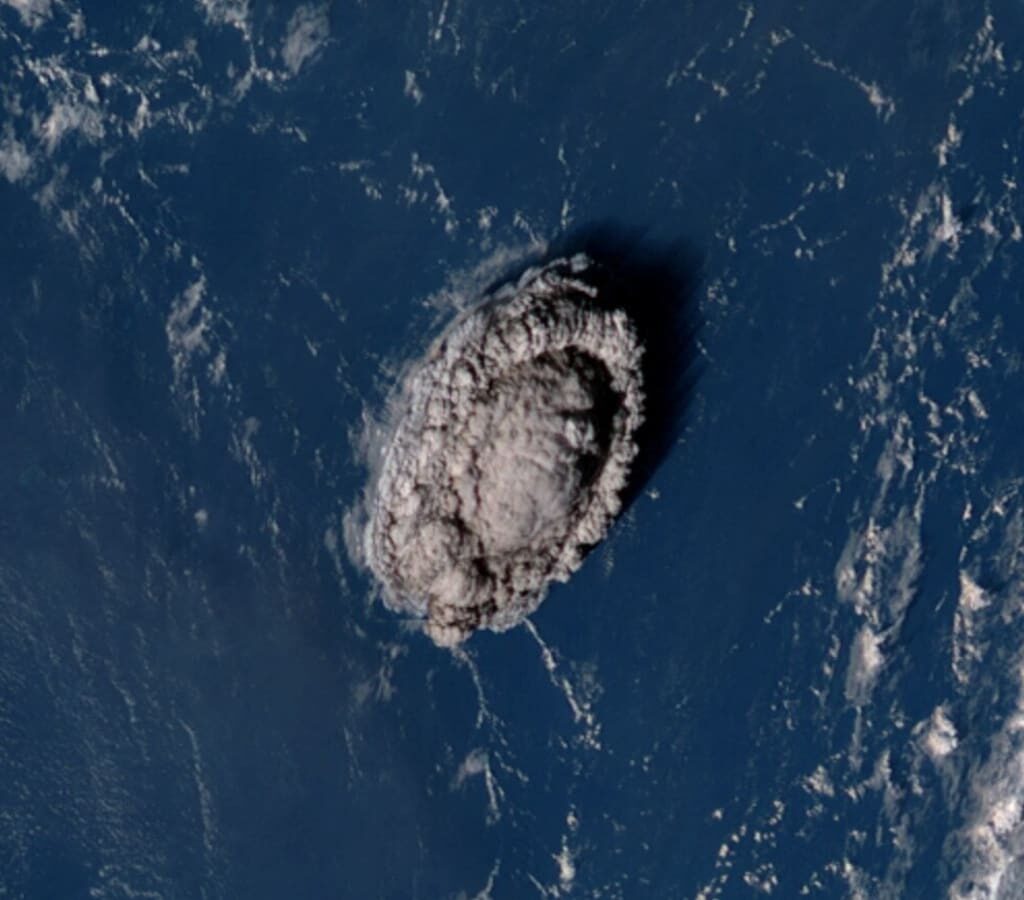
Hunga-Tonga-Hunga-Ha’apai erupted Jan. 15 marking the largest natural explosion in 30 years.
WINNIPEG, Jan. 17 (WeatherFarm) – Reportedly the largest natural occurring blast in about 30 years, the Jan. 15 eruption of an underwater volcano in the island nation of Tonga triggered tsunami warnings across the Pacific Ocean, including Canada.
However, reports said the eruption of Hunga-Tonga-Hunga-Ha’apai was unlikely to affect global temperatures despite its massive power. It’s estimated that a cloud of volcanic ash and sulfur dioxide (SO2) vaulted more than 30 kilometers above sea level. Having reached the stratosphere, the SO2 could remain airborne for years, but at a volume of approximately 0.4 teragrams (400 million kilograms), it’s far from enough to generate any climatic or weather changes, according to scientists.
In comparison, the 1991 blast of Mount Pinatubo in the Philippines produced 15 to 20 teragrams of SO2 and dropped the global temperature by 0.6 of a degree Celsius for 15 months. That said scientists believe Saturday’s eruption still could affect the climate in and around Tonga for the time being.
The eruption of Hunga-Tonga-Hunga-Ha’apai caused a tsunami in Tonga and pushed up water levels along the west coasts of the United States and Peru, according to reports. Communication outside of Tonga, both phone and Internet were cut-off in the blast, but have since been restored or were being brought back online.
Tonga’s capital, Nuku’alofa and 65 km from the volcano, was said to have suffered widespread damage from the tsunami, but so far there were no reports of deaths or injuries although a British woman is missing.
Australia and New Zealand sent military planes to the region of blast on Jan. 17 to better assess its effects.
Hunga-Tonga-Hunga-Ha’apai has been quite active, including a 2009 eruption breaching the surface and a 2015 blast created a new island that was two kilometres long, one km wide and 100 metres high. More recent eruptions occurred on Dec. 20. 2021 and on Jan. 13.
Prior to Jan. 15, Hunga-Tonga-Hunga-Ha’apai was estimated to have been 1,800 meters high and 20 km wide. Its eruption was a one-in-1,000-year blast.