
Studying new insights into past climate change
Ancient cemetery gives idea of stresses incurred by humans
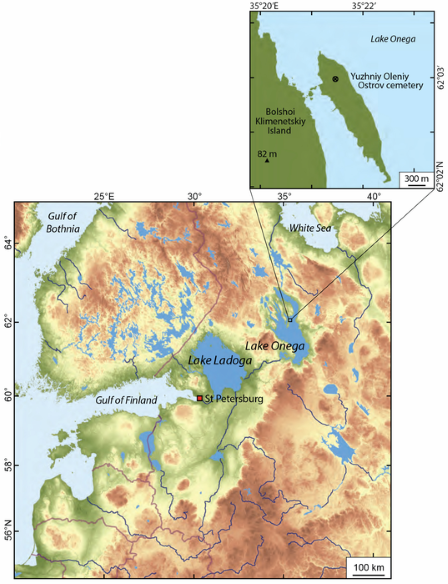
University of Oxford – An international team, from Oxford University’s School of Archaeology, led by Professor Rick Schulting, examined how our early ancestors dealt with major shifts in climate was revealed in Nature Ecology & Evolution.
New radiocarbon dating showed the large Early Holocene cemetery of Yuzhniy Oleniy Ostrov, at Lake Onega, some 500 miles north of Moscow, previously thought to have been in use for many centuries, was, in fact, used for only one to two centuries. Moreover, this seems to be in response to a period of climate stress.
The team believes the creation of the cemetery revealed a social response to the stresses caused by regional resource depression. At a time of climate change, Lake Onega, as the second largest lake in Europe, had its own ecologically resilient microclimate. This attracted game, including elk, to its shores while the lake itself provided a productive fishery. Because of the fall in temperature, many of the region’s shallower lakes could have been susceptible to the well-known phenomenon of winter fish kills, caused by depleted oxygen levels under the ice.
The creation of the cemetery at the site helped define group membership for what would have been previously dispersed bands of hunter-gatherers – mitigating potential conflict over access to the lake’s resources.
But when the climate improved, the team found, the cemetery largely went out of use, as the people presumably returned to a more mobile way of life and the lake became less central.
The behavioral changes – to what could be seen as a more ‘complex’ social system, with abundant grave offerings – were situation-dependent. But they suggested the presence of important decision makers and, say the team, the findings also implied that early hunting and gathering communities were highly flexible and resilient.
The results have implications for understanding the context for the emergence and dissolution of socioeconomic inequality and territoriality under conditions of socio-ecological stress.
Radiocarbon dating of the human remains and associated animal remains at the site revealed that the main use of the cemetery spanned between 100-300 years, centring on circa 8,250 to 8,000 before present (BP). This coincides remarkably closely with the dramatic cooling event approximately 8,200 years ago, so this site could provide evidence for how these humans responded to a climate-driven environmental change.
The Holocene (the current geological epoch which began approximately 11,700 years BP) has been relatively stable in comparison to current events. But there are a number of climate fluctuations recorded in the Greenland ice cores. The best known of these is the 8,200 years ago cooling event, the largest climatic downturn in the Holocene, lasting lasted one to two centuries. But there is little evidence that the hunter-gatherers, who occupied most of Europe at this time, were much affected, and if they were, in what specific ways.
Yuzhniy Oleniy Ostrov is one of the largest Early Holocene cemeteries in northern Eurasia, with up to 400 possible graves, 177 of which were excavated in the 1930’s by a team of Russian archaeologists. Based on their work, the cemetery site has an important position in European Mesolithic studies, in part because of the variation in the accompanying grave offerings. Some graves lack these entirely, to those with abundant and elaborate offerings.