Drought to persist in western Prairies: AccuWeather
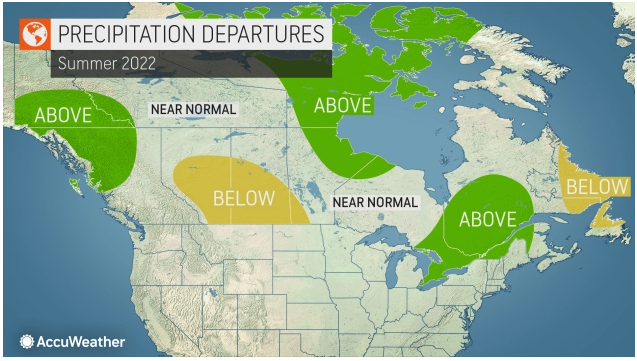
Precipitation departure map. Photo credit: AccuWeather
Precipitation departure map. Photo credit: AccuWeather.
AccuWeather – Weather forecasting service AccuWeather released its outlook of Canada’s 2022 summer season on May 24 and the news is not welcome for those living in the southern halves of Alberta and Saskatchewan.
While portions of western Canada are expected to encounter near-normal temperatures and near- to above-average rainfall, that will not be the case for other parts of the country.
“Ongoing and worsening severe drought across southern Alberta and southwestern Saskatchewan will likely feed the heat through the summer,” AccuWeather senior meteorologist Brett Anderson cautioned.
The drought conditions in place as of mid-May across a swath of the Prairies are not a good sign as summer approaches.
Almost all of the southern portions of both Alberta and Saskatchewan are at least experiencing abnormal dryness, according to the Canadian Drought Monitor. A large percentage of far southern Alberta was in the midst of an extreme drought, the second-highest drought classification, as of late May.
Dry ground is able to more easily radiate heat from the sun back into the lower levels of the atmosphere. This process raises the air temperature to a level several degrees higher than if the soil was moist.
“I expect a hotter summer compared to normal in cities such as Calgary and Regina,” Anderson said, citing the ongoing drought as a key reason that temperatures will soar above normal.
The continued dryness and increasing heat will also spell another danger for parts of the Prairies: wildfires.
“These dry and warm conditions will likely lead to a higher risk for large, rapidly spreading fires across the southern Prairies,” Anderson said.
The exceptions to this elevated heat and wildfire risk, at least in the early summer, are likely to be portions of southeastern Saskatchewan and southern Manitoba.
“The soil in these areas is still quite moist, with river flooding ongoing given recent rounds of heavy storms,” Anderson said.
When soil is too moist, it can present a problem for farmers attempting to plant crops, Anderson pointed out, but the increased moisture may be able to temper the potential for above-average heat through the early summer in the eastern Prairies. However, Anderson doubts that this buffer for the eastern Prairies will last the entire summer.
“Conditions may flip to drier and hotter during the second half of summer as the soil dries out,” Anderson cautioned.
As was the case for the winter and spring, a moderate La Niña phase is expected to persist into the summer, according to Anderson. Many across Canada are likely hoping not to experience a repeat of last summer. The summer of 2021 was certainly brutal at times, especially in southwestern Canada. June 2021 saw the country break its all-time record high temperature on three consecutive days. The mercury soared to an extraordinary 49.4 degrees C on June 29 in Lytton, located in southern British Columbia — a village that was engulfed by a devastating wildfire just about a week later. An average high temperature for that time of year in Lytton is in the mid-20s.
La Niña conditions tend to influence the orientation and position of the jet stream over North America. In this case, the projected position of the jet stream this summer is forecast to funnel more moisture over much of British Columbia.
“It’ll be wetter than normal across the northern part of the province with near-normal rainfall expected in the southern portion,” Anderson explained. “Given current conditions and the teleconnections expected to be in place, we may see a reduction in fire activity this year, especially when compared to last summer.”
AccuWeather forecasters say wet and stormy weather will be common across eastern Canada this summer.
Anderson has isolated a swath in eastern Canada extending from central and southern Ontario through western and southern Quebec as an area that will encounter above-normal precipitation and thunderstorm activity this summer.
“This may be a busy summer in terms of severe thunderstorms, especially from the Windsor to Toronto to Ottawa corridor,” Anderson cautioned.
While wet and stormy conditions may put a damper on some summer plans, the good news is that increased amounts of precipitation generally lead to lower overall drought risk.
“The risk of sustained summer drought in this region appears to be low at this point, with many areas set to experience near- to above-normal rainfall,” Anderson said.