
January 2023 sixth-warmest on record: NOAA
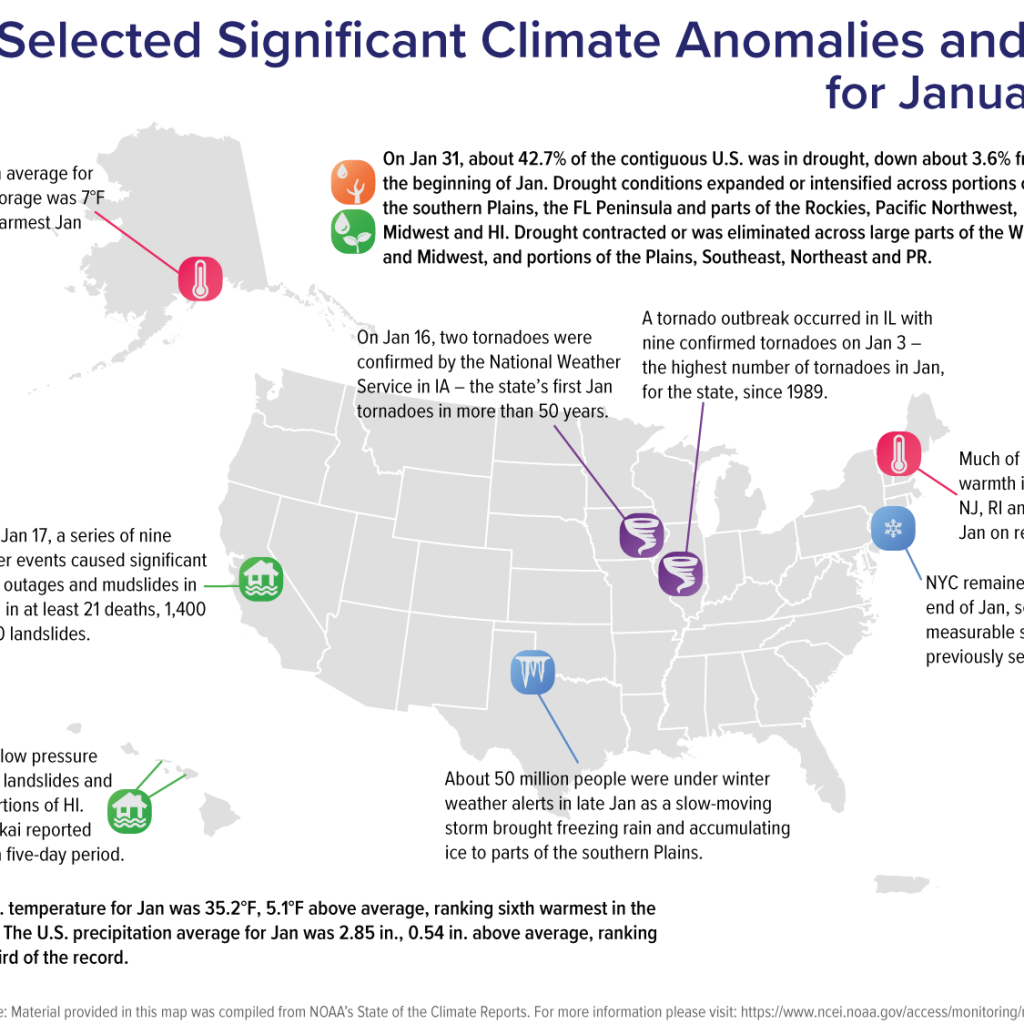
A map of the U.S. plotted with some of the most significant climate events that occurred during January 2023. Graphic: NOAA/NCEI
NOAA – The new year started off on a very warm note across the United States, with the nation seeing its sixth-warmest January on record, according to scientists from the National Oceanic and Atmospheric Administration’s (NOAA) National Centers for Environmental Information (NCEI).
The month was also plagued by a series of atmospheric rivers that brought historic rainfall and snow to the West, as numerous tornadoes struck other parts of the country.
The average January temperature across the contiguous U.S. was 35.2 degrees Fahrenheit (5.1 degrees above average), ranking as the sixth-warmest January on record.
Connecticut, Maine, Massachusetts, New Hampshire, New Jersey, Rhode Island and Vermont each had their warmest Januaries on record. Indiana, New York and Pennsylvania saw their second-warmest Januaries on record, with 17 additional states experiencing a top-10 warmest January.
The nation’s average precipitation across the contiguous U.S was 2.85 inches (0.54 of an inch above average), ranking among the wettest third of Januaries on record.
Nebraska saw its third-wettest January on record, with Massachusetts ranking fourth wettest and Rhode Island ranking seventh. Colorado, Iowa, New Hampshire and Utah each had a top-10 wettest January on record.
Other notable climate events
A series of nine atmospheric rivers from late December into mid-January dumped a record amount of rain and mountain snow across parts of the western U.S., hitting California particularly hard and causing significant damage to the region, including power outages. The weeks-long deluge resulted in at least 21 deaths and prompted more than 1,400 rescues throughout the state. The San Francisco Bay area experienced its wettest three-week period in 161 years.
January was notable for several weather systems that brought severe thunderstorms and an unusually high number of tornadoes to portions of the U.S. More than 100 tornadoes were confirmed, marking the third time since 1950 where 100 tornadoes occurred during January.
According to the January 31 U.S. Drought Monitor report, about 42.7 per cent of the contiguous U.S. was in drought, down about 3.6 per cent from the beginning of January.
Drought conditions expanded or intensified across portions of the southern Plains, the Florida Peninsula and parts of the Rockies, Pacific Northwest, Midwest and Hawaii. Drought conditions improved across large parts of the West and Midwest, and portions of the Plains, Great Lakes, Southeast, Northeast and Puerto Rico.