
Three trillion tonnes of ice lost
Net decline from 1996 to 2021
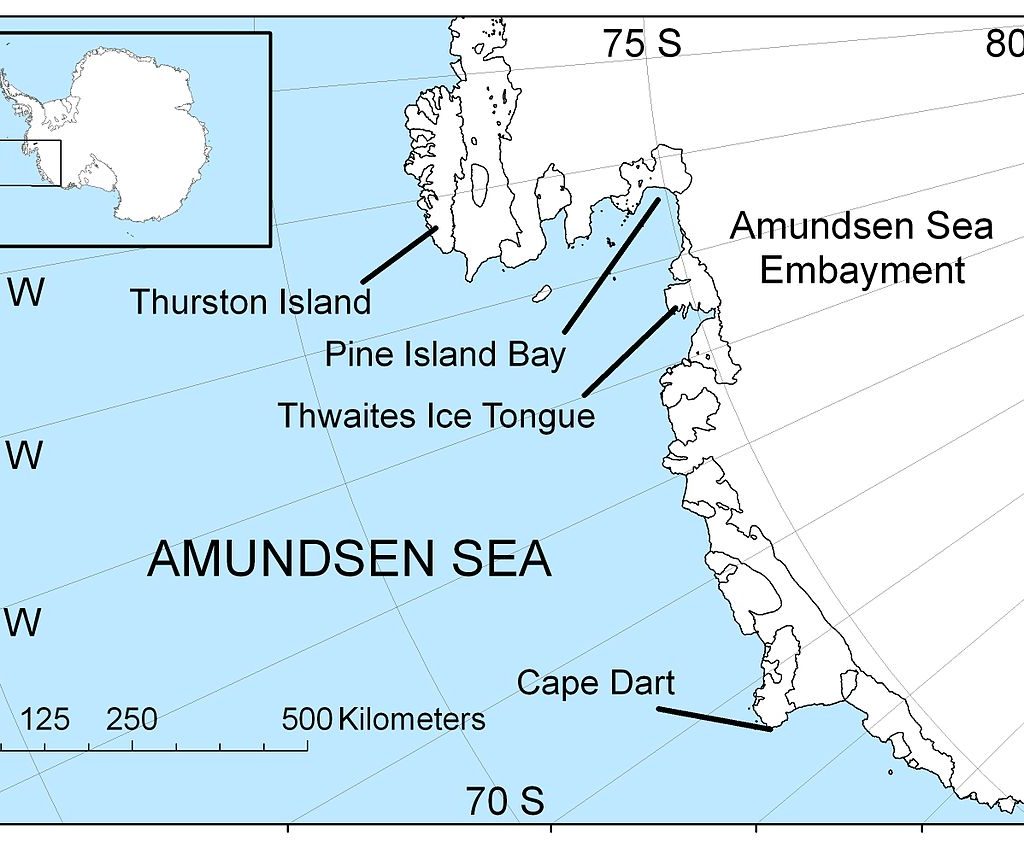
Amundsen Sea
University of Leeds (WeatherFarm) – Scientists have calculated that the fastest changing Antarctic region - the Amundsen Sea Embayment - has lost more than three trillion tonnes of ice over a 25-year period.
If all the lost ice were to cover Manhattan in New York City, it would stand at 61 kilometres high.
Twenty major glaciers form the Amundsen Sea Embayment in West Antarctica, which is more than four times the size of the United Kingdom, and they play a key role in contributing to the level of the world’s oceans.
So much water is held in the snow and ice, that if it were to all to drain into the sea, global sea levels could increase by more than one metre.
The research, led by Dr Benjamin Davison at the University of Leeds, calculated the “mass balance” of the Amundsen Sea Embayment. This describes the balance between mass of snow and ice gain due to snowfall and mass lost through calving, where icebergs form at the end of a glacier and drift out to sea.
When calving happens faster than the ice is replaced by snowfall, then the Embayment loses mass overall and contributes to global sea level rise. Similarly, when snowfall supply drops, the Embayment can lose mass overall and contribute to sea level rise.
The results show that West Antarctica saw a net decline of 3.33 trillion tonnes of ice between 1996 and 2021, contributing over nine millimetres to global sea levels. Changes in ocean temperature and currents are thought to have been the most important factors driving the loss of ice.
“The 20 glaciers in West Antarctica have lost an awful lot of ice over the last quarter of a century and there is no sign that the process is going to reverse anytime soon although there were periods where the rate of mass loss did ease slightly,” said Davidson.
“Scientists are monitoring what is happening in the Amundsen Sea Embayment because of the crucial role it plays in sea-level rise. If ocean levels were to rise significantly in future years, there are communities around the world who would experience extreme flooding,” he added.
Using climate models that show how air currents move around the world, the scientists identified that the Amundsen Sea Embayment had experienced several extreme snowfall events over the 25-year study period.
These would have resulted in periods of heavy snowfall and periods of very little snowfall or a “snow drought”.
The researchers factored these extreme events into their calculations. Surprisingly, they found that these events contributed up to half of the ice change at certain times, and therefore played a key role in the contribution the Amundsen Sea Embayment was making to sea level rise during certain time periods.
For example, between 2009 and 2013, the models revealed a period of persistently low snowfall, or “snow drought”. The lack of nourishing snowfall starved the ice sheet and caused it to lose ice, therefore contributing about 25 per cent more to sea level rise than in years of average snowfall.
In contrast, during the winters of 2019 and 2020 there was very heavy snowfall. The scientists estimated that this heavy snowfall mitigated the sea level contribution from the Amundsen Sea Embayment, reducing it to about half of what it would have been in an average year.
“Changes in ocean temperature and circulation appear to be driving the long-term, large-scale changes in West Antarctica ice sheet mass. We absolutely need to research those more because they are likely to control the overall sea level contribution from West Antarctic,” explained Davidson.
“However, we were really surprised to see just how much periods of extremely low or high snowfall could affect the ice sheet over two to five-year periods – so much so that we think they could play an important, albeit secondary role, in controlling rates of West Antarctic ice loss,” he continued.
“Ocean temperature changes and glacial dynamics appear strongly connected in this part of the world, but this work highlights the large variability and unexpected processes by which snowfall also plays a direct role in modulating glacier mass,” added Dr co-author Pierre Dutrieux, a scientist at the British Antarctic Survey.