
New study shows Earth energy imbalance
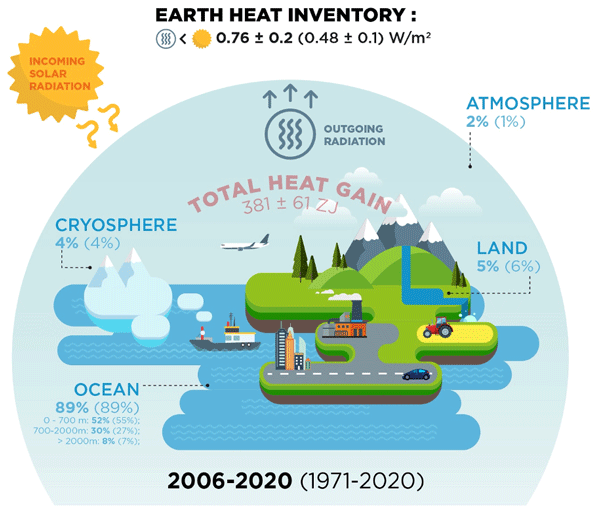
Graphic: World Meteorological Organization.
WMO – A new study suggests that the Earth climate system is out of energy balance as a result of human-induced climate change. Heat has accumulated continuously over the past decades, warming the ocean, the land, the cryosphere, and the atmosphere.
The study, Heat stored in the Earth system 1960-2020: where does the energy go?, shows that the Earth Energy Imbalance (EEI) continues to grow, and has risen by nearly 50 per cent over the past 14 years in comparison to the amount accumulated over the last half of a decade.
EEI, the difference between the amount of energy from the sun arriving at the Earth and the amount returning to space, serves as a fundamental metric to allow the World Meteorological Organization’s (WMO) co-sponsored Global Climate Observing System (GCOS) to assess how well the world responds to the task of bringing climate change under control. The recently published 2022 GCOS Implementation Plan highlights the importance of regularly assessing the gaps in the observing system underpinning EEI estimations and proposes actions to address them.
The international multidisciplinary study is published in Earth Systems Science Data, a prominent open-access journal of Copernicus Publications. It is led by Karina von Schuckmann of Mercator Ocean International, which contributes to WMO’s State of the Global Climate reports.
Researchers (nearly 70 from dozens of institutes across 15 countries) access careful calibrated cross-checked well-documented data from the ocean, land, ice and atmosphere to conclude:
- The Earth has accumulated nearly 0.5 watts over every square meter of Earth’s surface since 1971.
- From 2006 to 2020, heating increased to more than 0.75 watts per square metre.
- Most heat entered the ocean (89 per cent).
- Remaining global heat went into land (six per cent), ice (four per cent) and atmosphere (one per cent).
- Global assessment of energy gained and disbursed represents a fundamental metric of changing climate and its implications while warming the ocean, the land, the atmosphere and the cryosphere.
- Assessment efforts such as these require sustained international cooperation on monitoring and research.
“The Earth heat inventory in this study is underpinned by worldwide multidisciplinary collaboration and demonstrates the critical importance of concerted international efforts for climate change monitoring and community-based recommendations and we also call for urgently needed actions for enabling continuity, archiving, rescuing, and calibrating efforts to assure improved and long-term monitoring capacity of the global climate observing system,” the study’s authors wrote.