Nectar in grasslands stable after drought: study
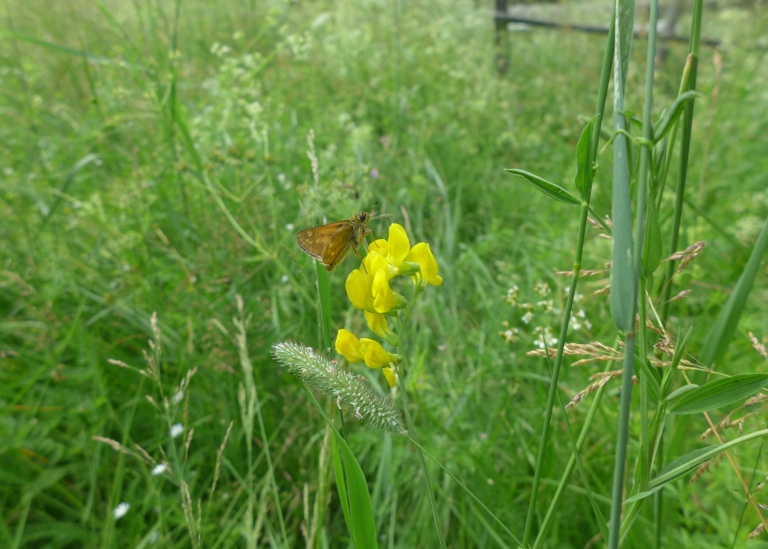
A pollinator in action on meadow pea (or gulvial, Lathyrus pratensis), the plant that provided most nectar in this study. Photo: Nina Roth.
Stockholm University – Researchers at Stockholm University in Sweden investigated the effects of soil amendments, i.e. compost, on floral resources in grasslands combined with the effects of drought.
Their results indicated that nectar provision in grasslands, with a native plant community and natural soil conditions, remains relatively stable under drought. The researchers also found that soil amendments increase floral resources in managed grasslands. The results are species specific, thus other plant communities might respond differently.
In recent decades, numerous studies have revealed a dramatic decrease in diversity and abundance of insect pollinators. One of the main reasons why insect pollinators are declining is a lack of floral resources due to land use change. The remaining semi-natural grasslands provide a vital supply of floral resources and nesting sites for pollinating insects.
Are droughts decreasing the amount of nectar available for pollinators – and if so, can we compensate for it by applying compost?
In order to answer these questions, a group of researchers at the Department of Physical Geography, Stockholm University, within the Bolin Centre for Climate Research, conducted both fieldwork and used an existing database on nectar values.
Drought effects on floral resources have been of growing research interest in recent years. However, most of those studies have been conducted in arid to semiarid regions or in laboratories/greenhouses, and there have been only few natural experiments in temperate regions. Moreover, those studies often focus on crop species, and are imposing only a single drought event. Therefore, the researchers in this study measured the effects of repeated droughts on wild herbaceous plant species in southern Sweden.
In agricultural landscapes, remaining semi-natural grasslands play a key role for providing floral resources for pollinators. However, droughts pose an increasing threat to the abundance and continuity of flowers. Soil amendments are a novel management tool for Swedish grasslands aiming to increase carbon sequestration and soil water holding capacity.
“In this study, we examined how drought is affecting floral resources (i.e. floral units, nectar quantity and nectar continuity) in grasslands with different mowing regimes, and if soil amendments (i.e. compost) could mitigate potential negative drought effects,” said Nina Roth, PhD student at the Department of Physical Geography, Stockholm University.
The study is part of a larger experiment, which was set up in 2019 to study the interactive effects of soil amendments, drought and mowing on carbon sequestration, yield and biodiversity. The experiment is located at the Tovetorp Research Station in southern Sweden. In 2021, the flowers in each plot were counted during the entire flowering season. The researchers observed a decrease in flowers under drought in the mown, but not in the abandoned plots. Nectar quantity and continuity over the season were not significantly affected by drought across both mowing regimes. The compost treatment had positive effects on the flower production, nectar quantity and continuity in the plots that were regularly mown.
Overall, the 37 flowering plant species in this study reacted differently to the treatments (increase vs. decrease in floral resources). Most of the nectar was provided by only few species (mainly Lathyrus pratensis, Vicia cracca and Anthriscus sylvestris).
“The experiment showed that nectar provision in grasslands with a native plant community and natural soil conditions remains relatively stable under an experimental drought. We also found that soil amendments increase floral resources (i.e. floral units, nectar quantity and continuity) in managed grasslands,” Roth explained.