
May extends a warm 2023
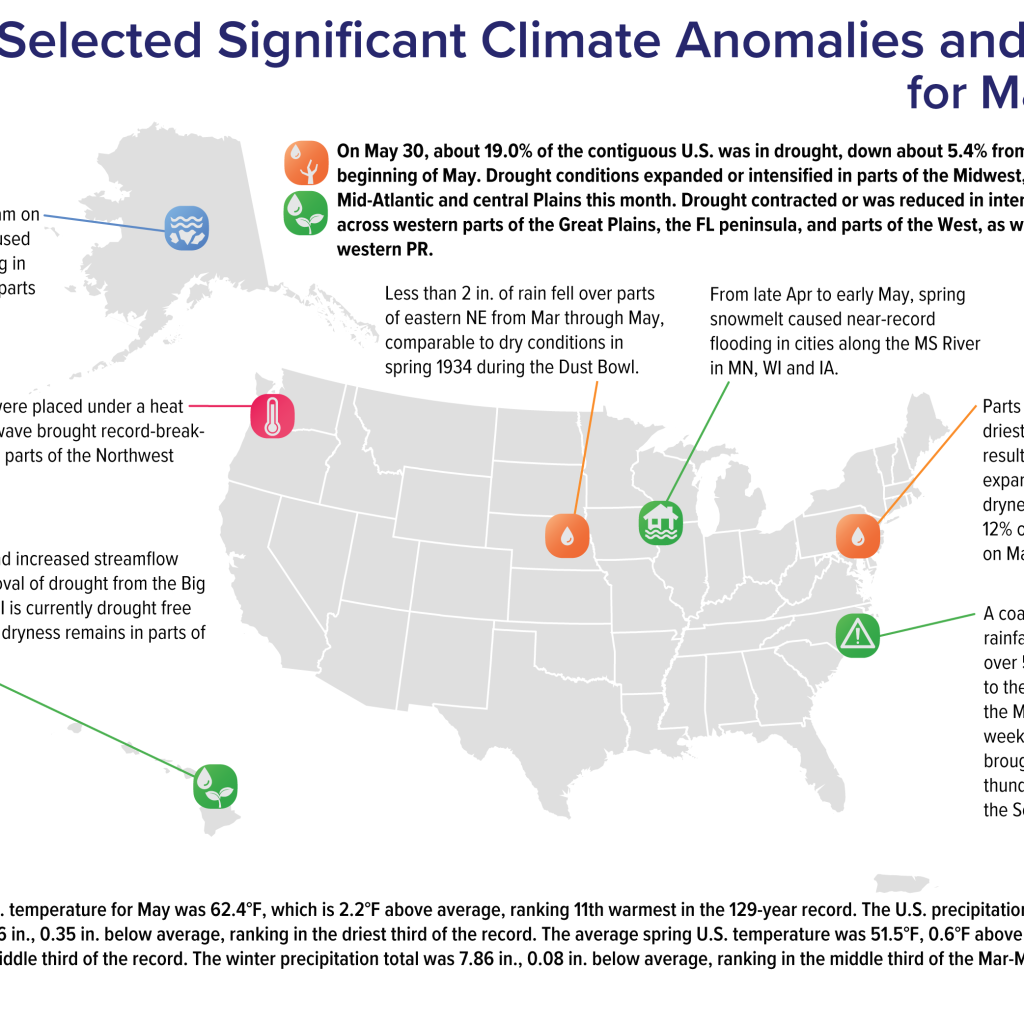
Credit: NOAA/NCEI
NOAA – May 2023 was quite warm across the contiguous U.S., ranking as the 11th-warmest May in the climate record.
The month also wrapped up a rather warm year so far, according to scientists from the National Oceanic and Atmospheric Administration’s (NOAA) National Centers for Environmental Information (NCEI).
The average May temperature across the contiguous U.S. was 16.9 degrees Celsius (1.2 degrees above the 20th-century average), ranking as the 11th-warmest May in NOAA’s 129-year climate record.
Temperatures were generally below average along the East Coast and above average across much of the West. Washington state had its warmest May on record while Minnesota, North Dakota, South Dakota and Wyoming each had a May that ranked as their top-five warmest. Idaho, Montana and Oregon saw their fifth-warmest May, while South Carolina’s May was the state’s 10th-coolest.
The average precipitation for May was 65 millimetres (8.9 mm below average), which ranked in the driest third of the record.
Precipitation was above average across much of the western Plains and West and in parts of the Southeast and New England. Precipitation was below average from the Mississippi River Valley to the Mid-Atlantic and southern New England, and in parts of the Northwest and central Rockies. Wisconsin saw its fourth-driest May on record while Pennsylvania saw its fifth driest. Maryland and Michigan ranked eighth and ninth driest on record, respectively. No state experienced a top-10 wettest May on record.
The average temperature for the contiguous U.S. during meteorological spring was 10.8 degrees C (0.3 of a degree above average), which ranked in the middle third of the climate record. Florida ranked fourth warmest while Massachusetts ranked 10th warmest on record for this spring season.
The spring precipitation total of 199.6 mm (2 mm below average) placed it in the middle third of the record. Maryland and Pennsylvania each ranked ninth driest on record while Kansas ranked 13th driest.
The average U.S. temperature for the year to date (January through May 2023) was 7.3 degrees C, one degree above average, ranking as the 18th-warmest such YTD on record.
Precipitation for the first five months of 2023 totaled 325.6 mm — 10.9 mm above average — ranking in the middle third of the record. January-through-May 2023 ranked as Utah’s 11th wettest and Nevada’s 13th wettest such period on record, while Maryland ranked fifth driest and Pennsylvania ranked 12th driest.
According to the May 30 U.S. Drought Monitor report, 19 per cent of the contiguous U.S. was in drought, down about 5.4 per cent from the beginning of May 2023. Drought coverage in the contiguous U.S. has dropped nearly 44 per cent over the last seven months, from 62.78 per cent on Nov. 11, 2022 to 18.95 per cent on May 30 — the fastest reduction in drought coverage since the start of the U.S. Drought Monitor report and the smallest drought footprint since May 26, 2020.
Several notable weather systems produced severe thunderstorms and a number of tornadoes that impacted portions of the U.S. last month.
A line of thunderstorms moved into southern Indiana and northern Kentucky on May 7. A total of six tornadoes was confirmed by NOAA’s National Weather Service (NWS), five of which occurred within a 15-minute span.
A tornado outbreak occurred across areas of central Oklahoma on May 11. A total of nine tornadoes was confirmed by NWS, snapping utility poles and damaging homes.
Severe thunderstorms produced several tornadoes on May 12, up to grapefruit-sized hail and flooding in parts of Nebraska. A total of 19 tornadoes, including three rated as EF-2, was confirmed by NWS.