
July 2023 hottest month on record: WMO
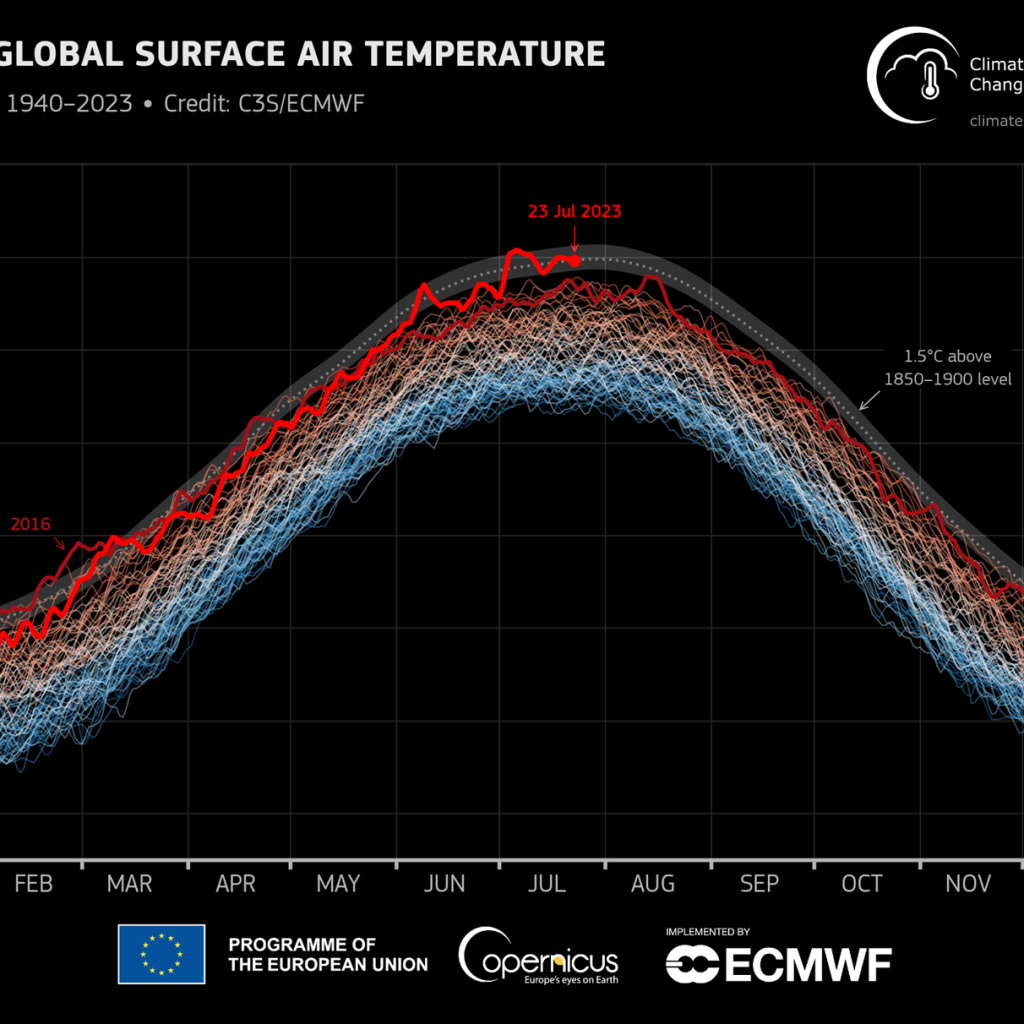
Global daily surface air temperature (°C) from 1 January 1940 to 23 July 2023, plotted as time series for each year. 2023 and 2016 are shown with thick lines shaded in bright red and dark red, respectively. Other years are shown with thin lines and shaded according to the decade, from blue (1940s) to brick red (2020s). The dotted line and grey envelope represent the 1.5°C threshold above preindustrial level (1850–1900) and its uncertainty. Data: ERA5. Credit: C3S/ECMWF.
WMO – According to ERA5 data from the EU-funded Copernicus Climate Change Service (C3S), the first three weeks of July have been the warmest three-week period on record and the month is on track to be the hottest July and the hottest month on record. These temperatures have been related to heatwaves in large parts of North America, Asia and Europe, which along with wildfires in countries including Canada and Greece, have had major impacts on people’s health, the environment and economies.
“We don’t have to wait for the end of the month to know this. Short of a mini-Ice Age over the next days, July 2023 will shatter records across the board,” said United Nations Secretary-General António Guterres.
“According to the data released (July 27), July has already seen the hottest three-week period ever recorded; the three hottest days on record; and the highest-ever ocean temperatures for this time of year,” he stated.
“For vast parts of North America, Asia, Africa and Europe – it is a cruel summer. For the entire planet, it is a disaster. And for scientists, it is unequivocal – humans are to blame. All this is entirely consistent with predictions and repeated warnings. The only surprise is the speed of the change,” Guterres added.
On July 6, the daily average global mean surface air temperature surpassed the record set in August 2016, making it the hottest day on record, with July 5 and 7 shortly behind. The first three weeks of July have been the warmest three-week period on record. Global mean temperature temporarily exceeded the 1.5 degree Celsius threshold above pre-industrial level during the first and third week of the month (within observational error). Since May, the global average sea surface temperature has been well above previously observed values for the time of the year; contributing to the exceptionally warm July.
It is extremely likely that July 2023 will be the hottest July and also the hottest month on record, following on from the hottest June on record. According to ERA5 data, the previous hottest month on record was July 2019.
“Record-breaking temperatures are part of the trend of drastic increases in global temperatures. Anthropogenic emissions are ultimately the main driver of these rising temperatures,” said Carlo Buontempo, Director of the Copernicus Climate Change Service (C3S). “July’s record is unlikely to remain isolated this year, C3S’ seasonal forecasts indicate that over land areas temperatures are likely to be well above average, exceeding the 80th percentile of climatology for the time of year.”
“The extreme weather which has affected many millions of people in July is unfortunately the harsh reality of climate change and a foretaste of the future,” said World Meteorological Organization (WMO) Secretary-General Petteri Taalas. “The need to reduce greenhouse gas emissions is more urgent than ever before. Climate action is not a luxury but a must.”
WMO predicts that there is a 98 per cent likelihood that at least one of the next five years will be the warmest on record and a 66 per cent chance of temporarily exceeding 1.5 C above the 1850 to 1900 average for at least one of the five years.
This does not mean that we will permanently exceed the 1.5 C level specified in the Paris Agreement which refers to long-term warming over many years.
According to the ERA5 dataset, the global mean surface air temperature reached its highest daily value (17.08 C) on July 6. This value was within 0.01 C of the values recorded on July 5 and 7. All days since July 3 have been hotter than the previous record of 16.80 C from Aug. 13, 2016.
The global mean surface air temperature average for the first 23 days of July 2023 was 16.95 C. This is well above the 16.63 C recorded for the full month of July 2019, which is currently the warmest July and warmest month on record. At this stage, it is virtually certain that the full monthly average temperature for July 2023 will exceed that of July 2019 by a significant margin, making July 2023 the warmest July and warmest month on record.
Daily sea surface temperatures (SSTs) averaged over the global extrapolar oceans (60°S to 60°N) have stayed at record values for the time of year since April 2023. Most notably, since about mid-May, global SSTs have risen to unprecedented levels for the time of year. According to ERA5 data, on July 19, the daily SST value reached 20.94 C, only 0.01 C shy of the highest value recorded for March 29, 2016 (20.95 C).
National meteorological and hydrological services have reported a number of daily and station temperature records and are responsible for verifying any new national temperature records. Thus, China set a new national temperature record of 52.2 C on July 16 (Turpan in Xinjiang province), according to the China Meteorological Administration. WMO’s provisional State of the Global Climate 2023 report, which will be presented to COP28 in December, will incorporate details of new national temperature records.
The temperature record for continental Europe of 48.8 C measured in Sicily on Aug. 11, 2021 was not broken during the July heatwaves, according to provisional information.
Phoenix, Ariz. on July 30 reported 31 consecutive days with a maximum daytime temperature of at least 43.3 C.