
2023 warmest year on record: WMO
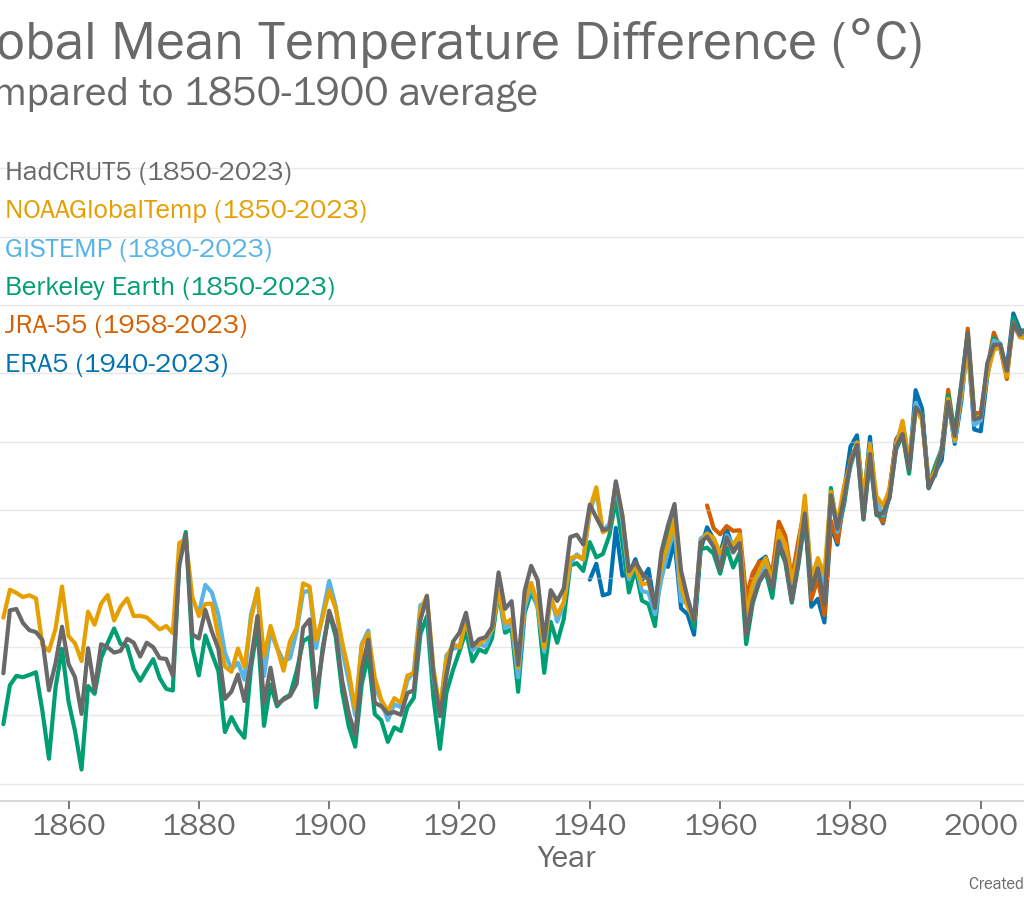
Global mean temperature difference compared to 1850 to 1900 average (World Meteorological Organization)
World Meteorological Organization – The annual average global temperature approached 1.5 degrees Celsius above pre-industrial levels in 2023 – symbolic because the Paris Agreement on climate change aims to limit the long-term temperature increase (averaged over decades rather than an individual year like 2023) to no more than 1.5 C above pre-industrial levels.
Six leading international datasets used for monitoring global temperatures and consolidated by the World Meteorological Organization (WMO) show that the annual average global temperature was 1.45 ± 0.12 C above pre-industrial levels (1850 to 1900) in 2023. Global temperatures in every month between June and December set new monthly records. July and August were the two hottest months on record.
“Climate change is the biggest challenge that humanity faces. It is affecting all of us, especially the most vulnerable,” said WMO Secretary-General Prof. Celeste Saulo, who took over the position on Jan. 1. “We cannot afford to wait any longer. We are already taking action but we have to do more and we have to do it quickly. We have to make drastic reductions in greenhouse gas emissions and accelerate the transition to renewable energy sources,” she said.
“The shift from cooling La Niña to warming El Niño by the middle of 2023 is clearly reflected in the rise in temperature from last year. Given that El Niño usually has the biggest impact on global temperatures after it peaks, 2024 could be even hotter,” Paulo added.
“While El Niño events are naturally occurring and come and go from one year to the next, longer-term climate change is escalating, and this is unequivocal because of human activities. The climate crisis is worsening the inequality crisis. It affects all aspects of sustainable development and undermines efforts to tackle poverty, hunger, ill-health, displacement, and environmental degradation.”
Since the 1980s, each decade has been warmer than the previous one. The past nine years have been the warmest on record. The years 2016 (strong El Niño) and 2020 were previously classed as the warmest on record, at 1.29 ±0.12 C and 1.27 ±0.12 C above the pre-industrial era.
Based on the six datasets, the ten-year average 2014 to 2023 was 1.20 ±0.12 C above the 1850 to 1900 average, factoring in a margin of uncertainty.
“Humanity’s actions are scorching the earth. 2023 was a mere preview of the catastrophic future that awaits if we don’t act now. We must respond to record-breaking temperature rises with path-breaking action,” said United Nations Secretary-General António Guterres.
“We can still avoid the worst of climate catastrophe. But only if we act now with the ambition required to limit the rise in global temperature to 1.5 C and deliver climate justice.”
Long-term monitoring of global temperatures is just one indicator of climate and how it is changing. Other key indicators include atmospheric greenhouse gas concentrations, ocean heat and acidification, sea level, sea ice extent and glacier mass balance.
WMO’s provisional State of the Global Climate in 2023 report, published on Nov. 30, showed that records were broken across the board.
Sea surface temperatures were exceptionally high for much of the year, accompanied by severe and damaging marine heatwaves. Antarctic sea ice extent was the lowest on record, both for the end-of-summer minimum in February and end-of-winter maximum in September.