
Warm, wet March in contiguous U.S.
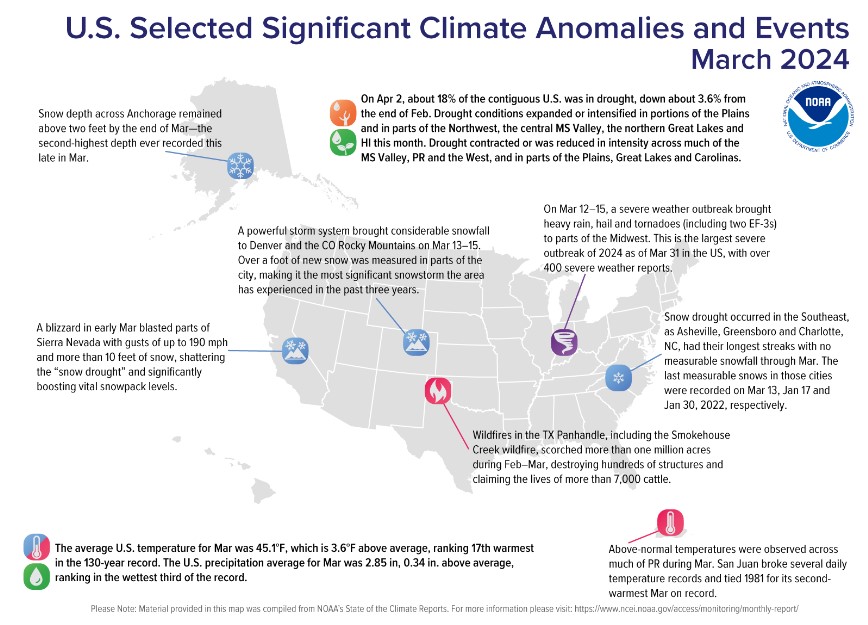
A map of the U.S. plotted with significant climate events that occurred during March 2024. Image credit: NOAA/NCEI
NOAA – March 2024 brought wild weather across the United States, as storms pounded parts of the nation and record-setting wildfires scorched more than a million acres, according to the U.S. National Oceanic and Atmospheric Administration (NOAA).
The month also capped off the fifth-warmest and 10th-wettest start to a year in NOAA’s 130-year climate record, according to experts and data from the National Centers for Environmental Information (NCEI).
The average monthly temperature across the contiguous U.S. was 7.28 degrees Celsius (1.95 C above the 20th-century average), which ranked as the 17th-warmest March in the climate record.
March temperatures were above average across much of the U.S., while below-average temperatures were observed in small pockets of the West and Southwest.
The average precipitation in the U.S. last month was 72.4 millimetres (8.66 mm above average), which ranked in the wettest third of the historical record.
Precipitation was above average across much of the West, in the Great Lakes and along the Gulf and East coasts, as well as parts of the northern Plains. Maine and Rhode Island each had their second-wettest March on record.
The average contiguous U.S. temperature for the year-to-date was 4.11 C (2.34 C above average), ranking as the fifth-warmest such YTD on record.
Maine, Michigan, New Hampshire, New York, Vermont and Wisconsin each had their second-warmest January-through-March period on record. An additional 15 states had their top 10 warmest such YTD on record.
The average precipitation for the first three months of 2024 was 207.01 mm — 30.23 above average — ranking as the 10th-wettest January-through-March on record.
Rhode Island had its second-wettest such YTD on record, and six additional states, Connecticut, Delaware, Maryland, Massachusetts, New Hampshire and New Jersey, saw their top 10 wettest YTD.
In mid-March, the U.S. was racked by devastating severe thunderstorms that brought baseball-sized hail and more than 20 tornadoes to portions of the Midwest, resulting in significant damage and loss of life.
A state of emergency was declared for Ohio as several tornadoes struck the state on March 14, resulting in three fatalities when an EF-3 tornado crossed Auglaize and Logan counties.
Five wildfires, including the Smokehouse Creek wildfire, were finally contained in the Texas Panhandle, the largest cattle-producing region in the world. The wildfires burned approximately 1.1 million acres, destroyed hundreds of structures, ruined hundreds of miles of fencing and killed more than 7,000 cattle.
One new billion-dollar weather and climate disaster was confirmed in March 2024 after a severe tornado event impacted the central and southern U.S. from March 13 to 15. The U.S. has sustained 378 separate weather and climate disasters since 1980 where overall damages/costs reached or exceeded US$1 billion (including CPI adjustment to 2024). The total cost of these 378 events exceeds US$2.675 trillion.