
Climate change destabilizes animal populations: study
Ecosystems could begin to break down
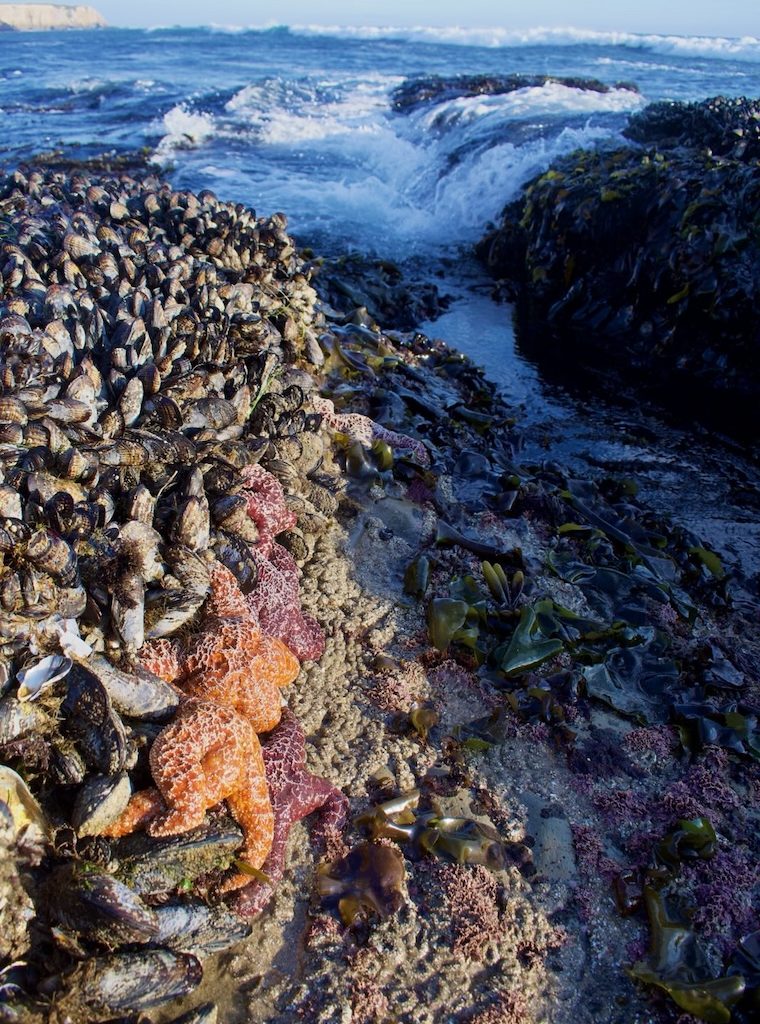
An intertidal species assemblage in Davenport Landing, California, USA. Species are being rapidly replaced in assemblages like this as temperatures change around the world. (Photo by Michael Kowalski)
University of California, Santa Cruz – A new study led by an ecology and evolutionary biologist at the University of California, Santa Cruz finds that temperature changes due to climate change have a doubly detrimental impact. Not only do they destabilize animal populations, but the impacts are accelerated as temperatures change more rapidly.
An international team of researchers found that changing temperatures — either warming or cooling — drive changes in the composition of species in an ecosystem. The results also suggested that behavioral adaptation and changing species interactions are not enough to preserve species composition in the face of higher rates of temperature fluctuations.
“It’s like shuffling a deck of cards, and temperature change now is shuffling that deck faster and faster,” said Prof. Malin Pinsky of UC Santa Cruz. “The worry is that eventually you start to lose some cards.”
The study’s findings are unique because the impacts of temperature change have often not been clear on land or in freshwater ecosystems. While impacts on ocean species have been more overt, and therefore easier to measure, plants and animals on land adapt in subtler ways, the researchers said.
The researchers focused on the rates of species replacement, which refers to the loss and gain of species over time. While this happens naturally, they found that the rate of replacement is increasing due to faster temperature changes.
If that trend continues, species could be lost and ecosystems could begin to break down, the study concluded. The most effective ways to avoid these outcomes are to avoid further global warming, preserve landscapes with a diversity of temperatures, and reduce the alteration of natural environments.
Benefits could include more abundant wildlife, clean water, and clean air.
“Temperature affects everything from how fast the heart beats to how flexible and porous our cell membranes are; from how much food animals eat to how fast plants grow,” said Pinsky. “Temperature is in many ways the metronome for life.”
In addition, the researchers found that species in ecosystems with less-varied habitats were more sensitive to temperature change than those with more diverse temperatures nearby. Whether due to natural conditions or human interference, not all environments have a diversity of temperatures to help protect the species that live in them. It is these animals that are most at risk due to faster temperature changes. Understanding the differing needs of species living in more or less varied environments can help society identify which ecosystems need the most attention and protection, the study concluded.
“Establishing this explicit link between rates of climate change and rates of species turnover allows us to better understand how changing temperatures can impact different ecosystems,” said senior author Shane Blowes. “Pinpointing factors that impact the rate of local species replacement can help prioritise conservation actions.”
Importantly, the researchers found that human impacts like land use, pollution, and introduction of invasive species exacerbate the impacts of temperature change on species replacement. This is possibly due to human activity reducing the diversity of landscapes and increasing stress on species that are already near their temperature limits.
To conserve ecosystems and their benefits to people, humans can help by “preserving more natural habitats, reducing pollution, and reducing the spread of invasive species,” Pinsky said. “In the ocean, factors like reduced fishing pressure and protecting habitats are important and helpful.”