Estuaries to become saltier, new research says
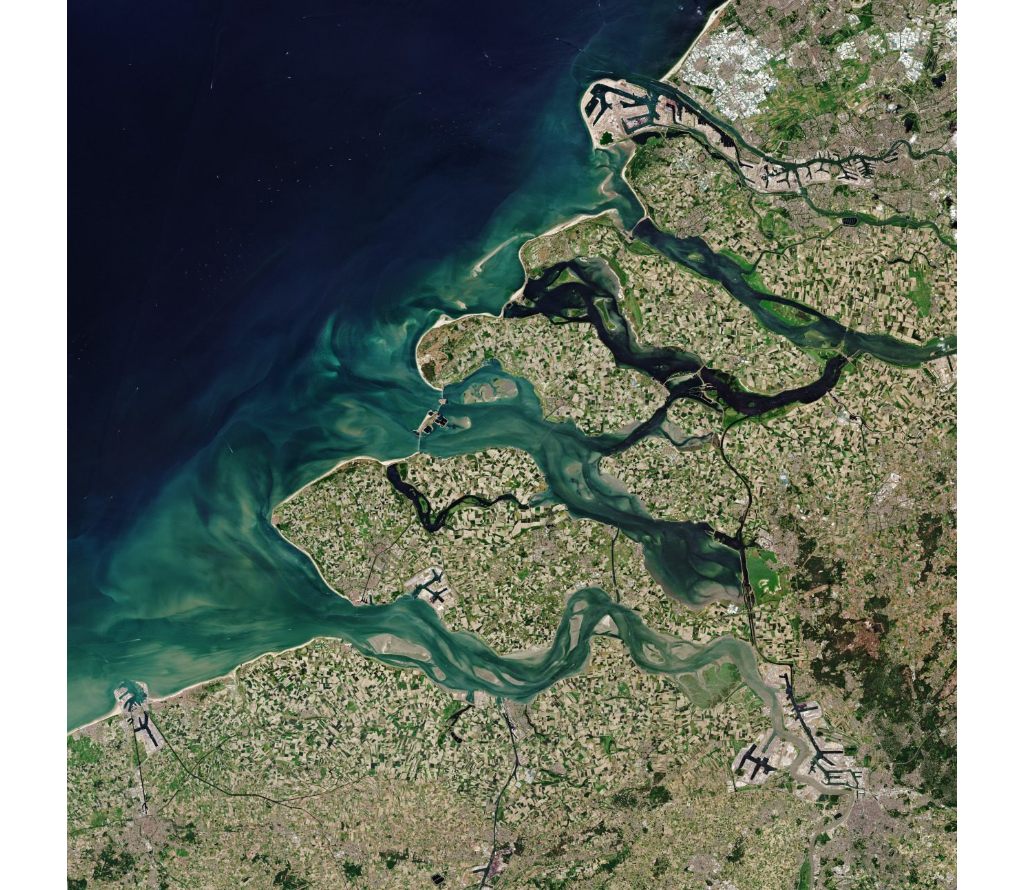
altwater and freshwater mix in estuaries—the transitional zones where rivers meet the sea (© ESA)
Utrecht University – New research by Utrecht University’s Institute for Marine and Atmospheric Research (IMAU), in collaboration with Dutch research institution Deltares, shows that estuaries will become saltier as climate change continues its rapid pace.
Estuaries are transitional zones between rivers and the sea where fresh and salt water meet, but salt water intrusion, where sea water pushes inland into rivers, is on the rise globally. By analysing 18 estuaries across the globe, researchers found that in 89 per cent of cases, the salt front is moving further upstream, primarily due to sea level rise and reduced river discharge, especially during the summer months. Regions experiencing drought and low river flows are expected to become increasingly salty over the coming decades.
As far back as the 10th century, Dutch farmers were draining their land, pumping out water to lower the groundwater level and making the soggy landscape suitable for agriculture. As the land began to subside, they built dikes to keep the sea at bay and preserve freshwater for farming and drinking.
But those conditions are changing, warns physical oceanographer Huib de Swart.
“During dry periods, when rivers carry less water, salt water can push much farther inland,” he said.
This is not just a local issue: salt water intrusion threatens freshwater availability in coastal regions across the world — a problem that is expected to intensify with climate change.
In this study, researchers examined changes in salt water intrusion. Using climate simulations, they projected future river discharges and relative sea level rise, allowing them to forecast salt water intrusion trends through the end of this century.
“This is the first study to assess the combined effects of changing river discharge and sea level rise on salt water intrusion at a global scale,” said climate physicist and project lead Henk Dijkstra.
Over the coming decades, decreasing river discharge poses the greatest climate-related risk to freshwater supplies. However, the study finds that by the end of this century, the impact of sea level rise on salt water intrusion could be roughly twice as great as that of reduced river flow. The likelihood of extreme salt water intrusion events — currently considered “once-in-a-century” phenomena — may increase by as much as 25 per cent.
Salt water is expected to reach further upstream in rivers, while seepage of saline groundwater may lead to saltier soils. This could have significant consequences for agriculture and ecosystems. Certain crops may struggle, and some forest areas could have difficulty surviving in saltier conditions.
De Swart emphasized regions that currently experience little to no salt water intrusion may face problems in the future.
“Right now, salt water can reach up to 35 kilometres inland during extreme events. Once every ten years, it may push up to 40 km. But our model projections show that this could become much more common—potentially every year,” he said. “In 100 years, the average salt water intrusion may extend 10 to 15 km further inland than it does today.”
According to De Swart, adaptation will be essential. Drinking water systems will need to be managed more carefully. For instance, storing water during wet months and reusing greywater, such as rainwater, for flushing toilets or irrigating gardens. Agriculture may need to switch to salt-tolerant crops and water-intensive industries like paper manufacturing will need to reassess whether their current practices remain viable.
“We’ll have to get used to the idea that unlimited access to fresh water is no longer a given,” De Swart concluded.