
Agriculture department officials address research cuts; to hold emergency study
By Karen Briere
| 4 min read

Public research is seen as critical to enhancing Canada’s productivity and efficiency throughout agriculture and all farm organizations have criticized the decision. Photo: File
Glacier FarmMedia — Members of the House of Commons agriculture committee from all parties expressed concern about the recently announced cuts and closures at federal research centres as they began an emergency study on the matter Feb. 10.
At least four meetings will be held.
The deputy minister of agriculture, Lawrence Hanson, and two assistants were the first witnesses to appear.
Hanson said as part of the comprehensive expenditure review across government, his department had to find $154.7 million in savings by 2028-29. Those savings are occurring across the department, but the coming changes to research operations have hit particularly hard.
WHY IT MATTERS: Public research is seen as critical to enhancing Canada’s productivity and efficiency throughout agriculture and all farm organizations have criticized the decision.
Hanson said the department’s operating budget is about $800 million annually, and science and research facilities account for about $300 million of that. In turn, $90 million of the $300 million is spent on corporate support, including maintenance and utilities associated with running 20 research centres and 25 satellite centres.
Most efficient use of funds
Over time, the facilities have required more upkeep.
“It was determined it would be a much more efficient use of funds to consolidate science efforts in fewer facilities and priorize science efforts that are most core to the department’s mandate, rather than diverting more and more resources to operational costs and upkeep,” Hanson said.
Thus the decision was made to close Quebec City, Guelph, Ont., and Lacombe, Alta., and four satellite farms at Scott and Indian Head in Saskatchewan, Portage la Prairie, Man., and Nappan, N.S.
He said 27 research scientists will not stay in their current location or be offered an equivalent position elsewhere. The federal government will remain the largest agricultural research organization in the country, he added, and every province will have at least one centre.
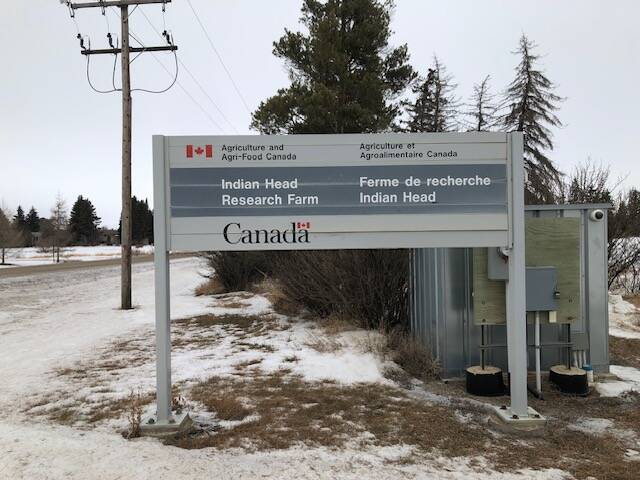
Regina-Qu’Appelle Conservative MP Andrew Scheer attended the meeting and said he was there to fight for the Indian Head farm, which employs 30 full-time employees and more during the summer.
Alain Legace, assistant deputy minister of corporate management, said the total operating cost for Indian Head is $3.8 million a year. Costs will continue because the divestiture will take years, he said.
Scheer asked if the department had assessed whether costs could be reduced and still keep the site open.
Hanson said the question isn’t whether the site could remain viable with more investment.
“The answer is, we have decided that the greatest level of savings and efficiency could come by consolidating our efforts elsewhere,” he said.
Some of the Indian Head research is to be moved to Outlook, Sask., where the federal government is a partner at the irrigation centre.
MPs pointed out that there are various soil types across the country, and research conducted at one site won’t necessarily fit elsewhere.
Andrew Goldstein, associate assistant deputy minister in the science and technology branch, said the department is aware of the differences, but with four sites in Saskatchewan remaining, it believes it can “generate sufficient diversity to continue our programs.”
Government spending criticized
Scheer and others criticized previous government spending of $8.5 million on a cricket farm and $8.2 million on a low-carbon rice program in Vietnam.
And some noted that a government Scheer was part of had cut the Prairie Farm Rehabilitation Administration and the Shelterbelt Centre at Indian Head about a dozen years ago.
Bloc Quebecois MP Sebastien Lemire said his region was affected during the 2012 cuts by the former Stephen Harper government, and his party is against the latest cuts.
Blaine Calkins, the Alberta Conservative MP for Ponoka-Didsbury, which includes the Lacombe Research Centre, said he hasn’t heard from anyone who thinks closing the centre is a good idea. He said the cuts are coming at the expense of producers and asked if the decision is reversible.
“We are not reconsidering this decision,” Hanson responded.
“We do believe that there are other people we can partner with and other universities and move some of this work elsewhere.”
Legace said it will take 12 months to wind down scientific activity. After that, the property will be divested following a Treasury Board process that requires it to be offered first to other government departments, then provincial and territorial governments and then municipalities and First Nations.
The officials said they could not guarantee any of the land would remain agricultural.