
Opinion: Is a closer trade relationship with China a security risk?
By Scott Garvey
| 3 min read
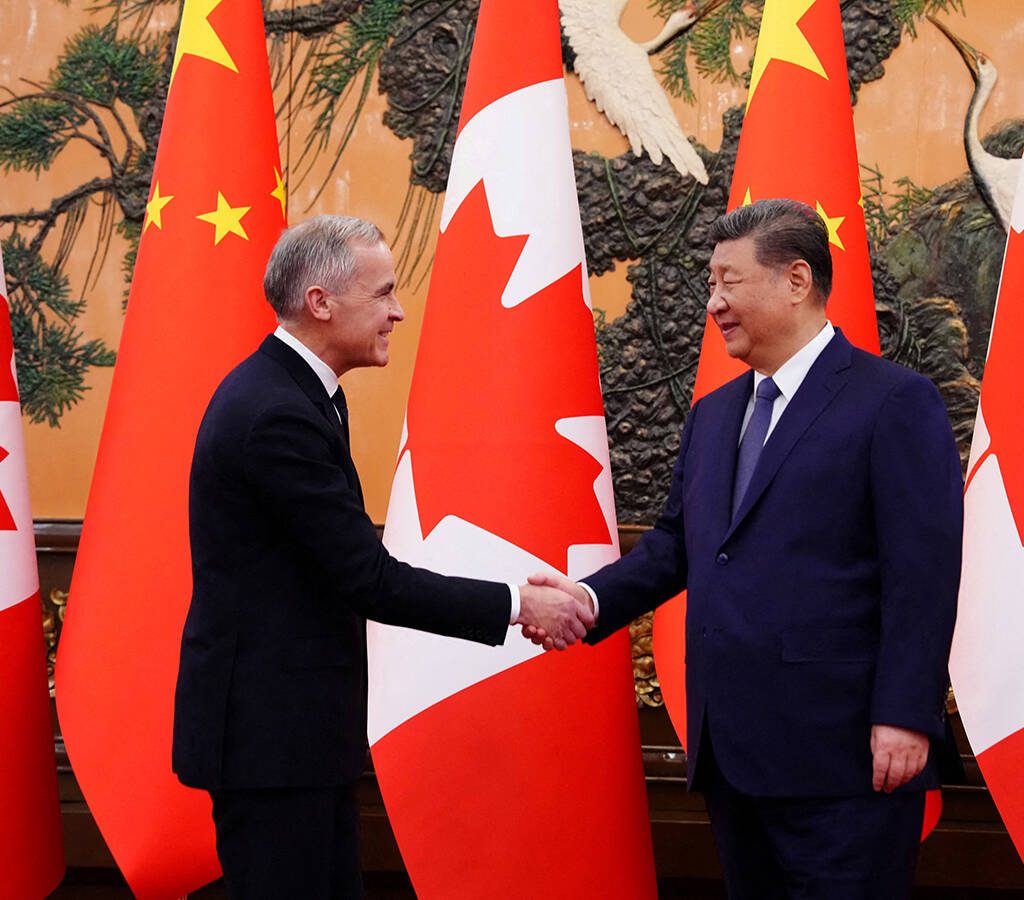
Canadian Prime Minister Mark Carney shakes hands with President of China Xi Jinping at the Great Hall of the People in Beijing, China on Friday, Jan. 16, 2026. Sean Kilpatrick/Pool via REUTERS
A week ago, the U.S. president reiterated his position that the United States will take control of Greenland, despite the Greenlandic and Danish governments’ vehement opposition.
“We’re going to do something on Greenland, whether they like it or not.”
He added that if he can’t make a deal to buy it, then the U.S. would do it “the hard way.”
By Jan. 15, several European nations had begun sending troops to Greenland to engage in defensive “exercises.”
On Jan. 16, Trump added that he would consider imposing tariffs on any country that did not support the unilateral U.S. acquisition of Greenland.
Add to that the killing of more than 100 civilians in boats in the Caribbean. These people were accused, without publicly providing evidence, of drug trafficking. Then there’s the temporary incursion into Venezuela to grab then-President Nicolas Maduro.
The U.S. president has shown a willingness to ignore legal boundaries both inside and outside his country to achieve his goals. That has led to very strained relationships with virtually every other western democracy, many of which are now looking to reduce their economic reliance on the U.S.
In November of last year, the U.S. administration spelled out its intention to dominate the countries in Western Hemisphere with the publication of its National Security Strategy.
“The United States rejects the ill-fated concept of global domination for itself,” the document reads. “The United States must be pre-eminent in the Western Hemisphere as a condition of our security and prosperity.”
Scott Lucas, professor of international politics , speaking on Times Radio in England in early January, said: “What you’ve got is beyond Trump’s renaming of the Monroe Doctrine, is the 20th century version of 19th century U.S. colonialism … but it’s on steroids now.
“The Trump corollary is, ‘we control the Western Hemisphere, militarily, economically and politically.’ That’s the wider play.”
In the face of that, Prime Minister Mark Carney announced a new agreement with China on Jan. 16. It’s part of a move to restore overall relations with that country, in part to limit economic risk from U.S. actions.
But China, too, has been an aggressive and dangerous threat to our national sovereignty and security.
“We spent a fair bit of time in those meetings about the guardrails, if you will, of that relationship, where we felt we could co-operate, respecting each other’s view in the system,” Carney said during a press conference announcing the deal.
“The candid dialogue leads to a more predictable and effective relationship (than with the U.S.).”
But there are risks.
In March 2024, a parliamentary committee released a report on so-called Chinese foreign police stations, which claimed that China had established 54 overseas police stations in 30 different countries, including Canada.
A follow-on report entitled Patrol and Persuade, published in December 2022, claimed that 102 OPS were present in 53 countries.”
The RCMP and the FBI both have publicly announced investigations into these activities in Canada and the U.S.
These clandestine stations have reportedly been used to intimidate and extend the reach of the PRC government to expatriate Chinese citizens living abroad.
In 2024, the CBC reported on a CSIS investigation revealing that Chinese-sponsored actors had infiltrated 20 cyber networks related to the Canadian government and obtained classified information as a result.
A report from the Communications Security Establishment Canada, looking ahead to the 2025-26 fiscal year, names China as “the most comprehensive cyber security threat facing Canada today.”
In 2023 the Globe and Mail broke the story that Conservative MP Michael Chong was targeted for harassment by the Chinese government after a vote in the House condemning China over its treatment of the Uyghur minority. This was part of a larger attempt to interfere in Canadian politics.
Parliament’s National Security and Intelligence Committee released a report as far back as 2020 that stated, “the threat from espionage and foreign interference is significant and continues to grow. Several states are responsible for conducting such activities in Canada, but intelligence shows that China and Russia remain the primary culprits.“
When it comes to looking for major trading partners in 2026, there are no easy choices.