
2023 breaks climate records: WMO
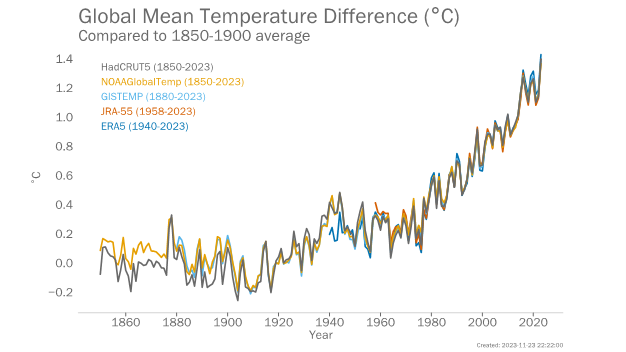
Global Mean Temperature Difference (compared to 1850 to 1900)
World Meteorological Organization – 2023 has shattered climate records, accompanied by extreme weather which has left a trail of devastation and despair, according to the World Meteorological Organization (WMO).
The WMO provisional State of the Global Climate report confirms that 2023 is set to be the warmest year on record. Data until the end of October shows that the year was about 1.40 degrees Celsius (with a margin of uncertainty of ±0.12°C) above the pre-industrial 1850 to 1900 baseline. The difference between 2023 and 2016 and 2020 – which were previously ranked as the warmest years – is such that the final two months are very unlikely to affect the ranking.
The past nine years, 2015 to 2023, were the warmest on record. The warming El Niño event, which emerged during the Northern Hemisphere spring of 2023 and developed rapidly during summer, is likely to further fuel the heat in 2024 because El Niño typically has the greatest impact on global temperatures after it peaks.
“Greenhouse gas levels are record high. Global temperatures are record high. Sea level rise is record high. Antarctic sea ice is record low. It’s a deafening cacophony of broken records,” said WMO Secretary-General Dr. Petteri Taalas.
“These are more than just statistics. We risk losing the race to save our glaciers and to rein in sea level rise. We cannot return to the climate of the 20th century, but we must act now to limit the risks of an increasingly inhospitable climate in this and the coming centuries.”
Carbon dioxide levels are 50 per cent higher than the pre-industrial era, trapping heat in the atmosphere. The long lifetime of carbon dioxide means that temperatures will continue to rise for many years to come.
The rate of sea level rise from 2013 to 2022 is more than twice the rate of the first decade of the satellite record (1993 to 2002) because of continued ocean warming and melting of glaciers and ice sheets.
The maximum Antarctic sea-ice extent for the year was the lowest on record, a full one million square kilometres (more than the size of France and Germany combined) less than the previous record low, at the end of southern hemisphere winter. Glaciers in North America and Europe once again suffered an extreme melt season. Swiss glaciers have lost about 10 percent of their remaining volume in the past two years, according to the WMO report.
“This year we have seen communities around the world pounded by fires, floods and searing temperatures. Record global heat should send shivers down the spines of world leaders,” said United Nations (UN) Secretary-General António Guterres.
In a video message accompanying WMO’s climate report, Guterres urged leaders to commit to urgent action at the UN Climate Change negotiations COP28 in Dubai.
“We have the roadmap to limit the rise in global temperature to 1.5 C and avoid the worst of climate chaos. But we need leaders to fire the starting gun at COP28 on a race to keep the 1.5 degree limit alive: By setting clear expectations for the next round of climate action plans and committing to the partnerships and finance to make them possible, by committing to triple renewables and double energy efficiency, and committing to phase out fossil fuels with a clear time frame aligned to the 1.5-degree limit,” he said.
Renewable energy capacity grew nearly 10 per cent in 2022, led by solar and wind power.
The final State of the Global Climate 2023 report, along with regional reports, will be published in the first half of 2024.