
2024 on track to be hottest year on record: WMO
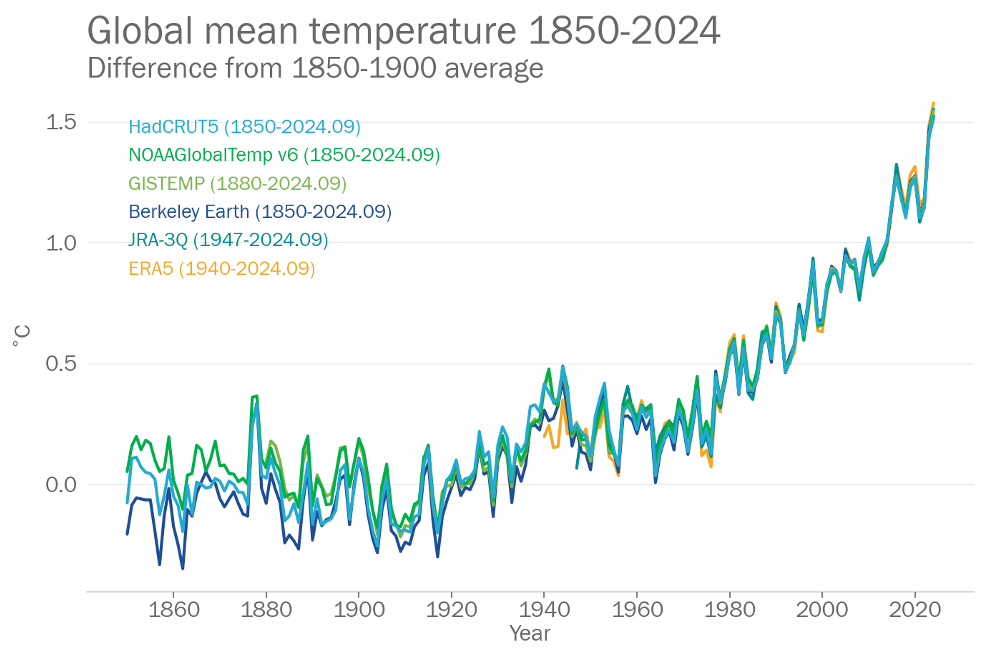
Annual global mean temperature anomalies from January – September 2024 (relative to the 1850-1900 average) from six international datasets.
World Meteorological Organization – This year remained on track to be the warmest year on record after an extended streak of exceptionally high monthly global mean temperatures, said the World Meteorological Organization.
The WMO State of the Climate 2024 Update again issued a Red Alert at the sheer pace of climate change in a single generation, turbo-charged by ever-increasing greenhouse gas levels in the atmosphere. The period of 2015 to 2024 will be the warmest 10 years on record due to the loss of ice from glaciers and the acceleration of sea-level rise and ocean heating, while extreme weather is wreaking havoc on communities and economies across the world.
The January to September 2024 global mean surface air temperature was 1.54 degrees Celsius (with a margin of uncertainty of ±0.13 C) above the pre-industrial average, boosted by a warming El Niño event, said an analysis of six international datasets.
“Climate catastrophe is hammering health, widening inequalities, harming sustainable development, and rocking the foundations of peace. The vulnerable are hardest hit,” said United Nations Secretary-General António Guterres.
The report was issued on the first day of the UN Climate Change Conference, COP29, in Baku, Azerbaijan. It highlights that the ambitions of the Paris Agreement are in great peril.
“As monthly and annual warming temporarily surpass 1.5 C, it is important to emphasize that this does NOT mean that we have failed to meet Paris Agreement goal to keep the long- term global average surface temperature increase to well below 2 C above pre-industrial levels and pursue efforts to limit the warming to 1.5 C,” said WMO Secretary-General Celeste Saulo.
“Recorded global temperature anomalies at daily, monthly and annual timescales are prone to large variations, partly because of natural phenomena such as El Niño and La Niña. They should not be equated to the long-term temperature goal set in the Paris Agreement, which refers to global temperature levels sustained as an average over decades,” Saulo continued.
“However, it is essential to recognize that every fraction of a degree of warming matters. Whether it is at a level below or above 1.5 C of warming, every additional increment of global warming increases climate extremes, impacts and risks. The record-breaking rainfall and flooding, rapidly intensifying tropical cyclones, deadly heat, relentless drought and raging wildfires that we have seen in different parts of the world this year are unfortunately our new reality and a foretaste of our future.”