
2024 warmest year on record: NOAA
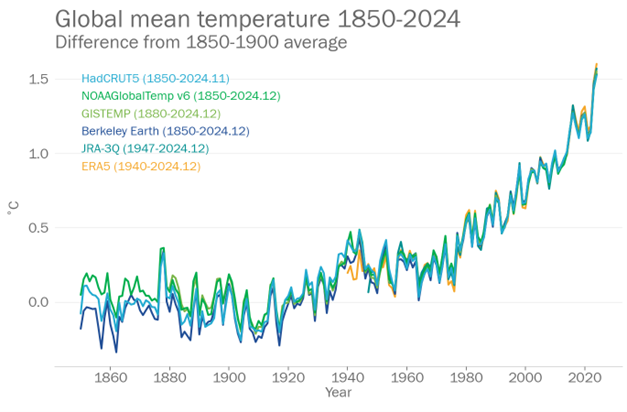
Graphic credit: World Meteorological Organization
National Oceanic and Atmospheric Administration – It’s official: 2024 was the planet’s warmest year on record, according to the National Oceanic and Atmospheric Administration’s National Centers for Environmental Information (NCEI).
Along with historic heat, Antarctic sea ice coverage dropped to its second-lowest extent (coverage) on record.
Earth’s average land and ocean surface temperature in 2024 was 1.29 degrees Celsius above the 20th-century average — the highest global temperature among all years in NOAA’s 1850 to 2024 climate record. It was 0.10 C warmer than 2023, which was previously the warmest year on record.
Regionally, Africa, Europe, North America, Oceania and South America (tied with 2023) had their warmest year on record. Asia and the Arctic had their second-warmest year on record.
The planet’s 10 warmest years since 1850 have all occurred in the past decade. In 2024, global temperature exceeded the pre-industrial (1850 to 1900) average by 1.46 C.
Other scientific organizations, including NASA, the Copernicus Climate Change Service and the United Kingdom’s Meteorological Office have conducted separate but similar analyses that also rank 2024 as the warmest year on record.
Antarctic sea ice extent averaged 10.360 million square kilometres in 2024, the second lowest on record. The maximum extent in September was 17.068 million square km, which ranked second-lowest, and the minimum extent in February was 2.15 million square km, which also ranked second-lowest. Arctic sea ice extent averaged 10.438 million square km in 2024, seventh-lowest on record. The maximum extent in March was 14.867 million square km, which ranked 15th-lowest, while the minimum extent in September was 4.377 million square km, which ranked sixth-lowest.
The 2024 upper ocean heat content, which is the amount of heat stored in the upper 2,000 meters of the ocean, was the highest on record. Ocean heat content is a key climate indicator because the ocean stores 90 per cent of the excess heat in the Earth system. The indicator has been tracked globally since 1958, and the five highest values have all occurred in the last five years.
Eighty-five named storms occurred across the globe in 2024, which was near the 1991 to 2020 average of 88. Forty-two of those reached tropical cyclone strength (sustained winds of 119 km/h or higher), and 23 reached major tropical cyclone strength (sustained winds of 179 km/h or higher). These also included four storms that reached Category 5 (sustained winds of 253 km/h or higher) on the Saffir-Simpson hurricane wind scale. The global accumulated cyclone energy (ACE) was about 21 per cent below the 1991 to 2020 average.