Antarctic ozone hole smallest in five years
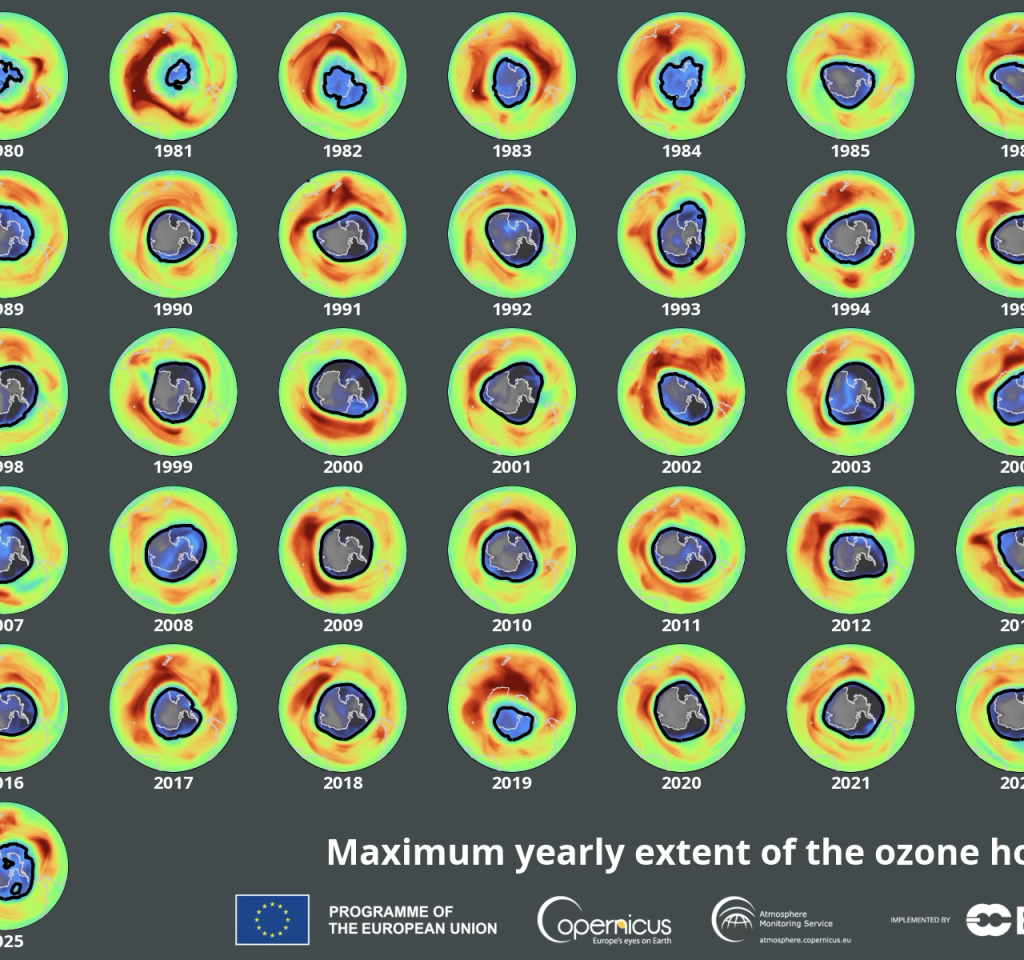
Copernicus ECMWF/Atmospheric Monitoring Service
World Meteorological Organization – The ozone layer over Antarctica continued to repair itself in 2025.
Scientists from NASA and the National Oceanic and Atmospheric Administration in the United States reported earlier this month that the Antarctic ozone hole at its maximum extent was the smallest in five years and the fifth-smallest since 1992. The Copernicus Atmosphere Monitoring Service also confirmed the hole closed at its earliest date since 2019 on Dec. 1.
The ozone hole is usually at its biggest during spring in the Southern Hemisphere and its size is determined by temperatures and winds in the stratosphere as well as human-emitted ozone depleting substances.
The ozone hole’s average extent, during its depletion season from Sept. 7 to Oct. 13, was 18.71 million square kilometres, 30 per cent smaller than the largest hole ever observed in 2006. It is also closing three weeks earlier on average this decade than in the decade before.
“Our scientific monitoring confirms our predictions that the ozone layer is well on track to recovery thanks to the Montreal Protocol and its phase-out of the vast majority of ozone depleting chemicals which were once used in refrigeration, air conditioning, firefighting foam and even hairspray,” said Paolo Laj, Chief of Atmospheric and Environment Research Section for the World Meteorological Organization.
“We are confident that the ozone layer can return to 1980s levels by the middle of this century, significantly reducing risks of skin cancer, cataracts, and ecosystem damage due to excessive UV exposure. But we must avoid complacency and continued scientific monitoring is essential.”
The Montreal Protocol, which phased out most ozone-depleting substances including chlorofluorocarbons (CFCs) is considered one of the most successful environmental treaties. Adopted on Sept. 16, 1987, the protocol went into effect in 1992 and is one of the rare treaties to achieve universal ratification.
In the WMO’s most recent assessment in 2022, the ozone layer is expected to recover to 1980 levels — before the ozone hole was discovered — by 2066 over the Antarctic, 2045 over the Arctic and 2040 in the rest of the world. There will be another assessment conducted in 2026.