
April 2023 fourth-warmest on record: NOAA
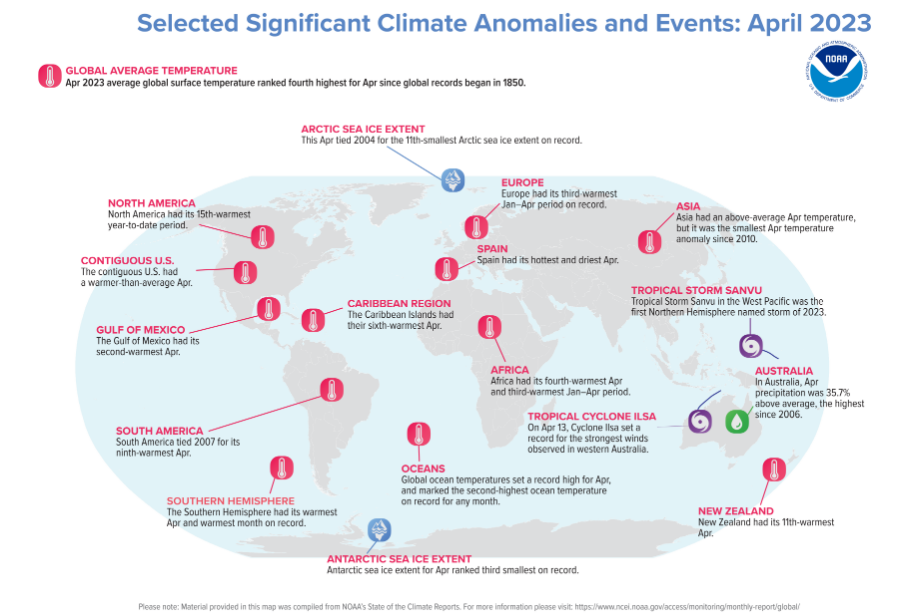
A map of the world plotted with some of the most significant climate events that occurred during April 2023. Please see the story below as well as more details in the report summary from NOAA NCEI at http://bit.ly/Global202304offsite link. (Image credit: NOAA/NCEI)
NOAA – Last month added to the planet’s warm year so far, as April 2023 ranked as the world’s fourth-warmest April on record.
Earth’s global ocean temperatures were record high for the month, and the second-warmest for any month on record, according to scientists from the National Oceanic and Atmospheric Administration’s (NOAA) National Centers for Environmental Information (NCEI).
The average global temperature in April was one degree Celsius above the 20th-century average of 13.7 C, ranking as the fourth-warmest April in NOAA’s 174-year climate record. April 2023 marked the 49th consecutive April and the 530th consecutive month with temperatures above the 20th-century average.
The Southern Hemisphere had its warmest April and warmest month on record. The April 2023 temperature surpassed that of the previous record-warm month — March 2016 — by 0.06 C. Meanwhile, the Northern Hemisphere had its ninth-warmest April on record.
Looking at continents, Africa had its fourth-warmest April on record, while South America tied 2007 for its ninth-warmest April. North America, Europe and Oceania had an above-average April temperature, but didn’t rank among the top 20 warmest Aprils on record.
Global ocean temperatures set a record high for April at 0.86 C above the long-term average. This marked the second-highest monthly ocean temperature for any month on record, just 0.01 C shy of the record-warm ocean temperatures set in January 2016.
The global temperature for the year to date (January through April 2023) ranked as the fourth warmest such period on record at 1.03 C above the 1901 to 2000 average of 12.6 C.
According to NCEI’s Global Annual Temperature Rankings Outlook, there is a virtually certain chance (greater than 99 per cent) that 2023 will rank among the 10 warmest years on record, and an approximately 93 per cent chance it will rank among the top five.
Globally, April 2023 saw the third-smallest April sea ice extent (coverage) on record. Arctic sea ice extent in April was approximately 130,000 square miles below the 1991 to 2020 average, which tied with April 2004 as the 11th smallest April extent in the 45-year record. Meanwhile, the April 2023 Antarctic sea ice extent ranked third lowest on record, approximately 560,000 square miles below average.
Three named storms occurred in April across the globe, statistics that are below the 1991 to 2020 average for the month. Two of those storms, Herman and Ilsa, occurred in the Australian region and reached major tropical cyclone strength (winds of 179 kilometres per hour or higher). Cyclone Ilsa’s landfall set a new record for the strongest winds observed in western Australia. The third was Tropical Storm Sanvu in the West Pacific — the first named storm of 2023 for the Northern Hemisphere.