
Atlantic hurricane season ends
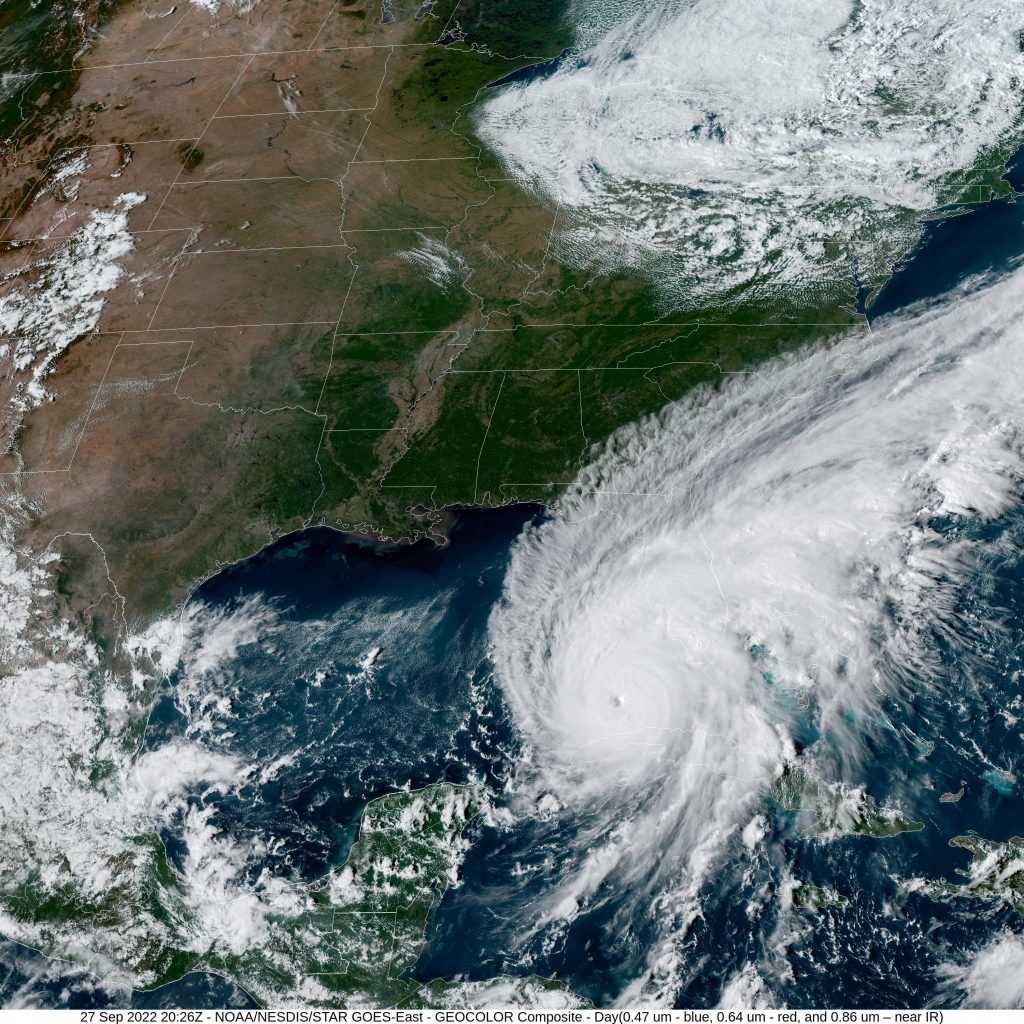
Hurricane Ian as seen from NOAA’s GOES-East satellite on Sept. 27, 2022 at 4:26 p.m. (EDT) in the Gulf of Mexico. (NOAA)
NOAA – The 2022 Atlantic hurricane season officially ended on Nov. 30, according to the National Oceanic and Atmospheric Administration (NOAA), but the impact of Hurricanes Ian, Nicole and Fiona — which brought extensive damage to Florida’s coast and Puerto Rico, respectively — will continue to be felt long after the season is over.
In total, this hurricane season produced 14 named storms (winds of 39 miles per hour or greater), of which eight became hurricanes (winds of 74 mph or greater) and two intensified to major hurricanes with winds reaching 111 mph or greater. An average hurricane season has 14 named storms, seven hurricanes and three major hurricanes.
The 2022 season saw three hurricane landfalls along the coast of the U.S. mainland. Hurricane Ian made landfall first as a Category 4 storm in Cayo Costa, Florida, and again as a Category 1 in Georgetown, South Carolina. As a Category 4 with 150 mph maximum sustained winds, Hurricane Ian tied for the fifth-strongest hurricane ever to make landfall in the U.S. Hurricane Nicole made landfall as a Category 1 in north Hutchinson Island, Florida.
Hurricane Fiona made landfall outside of the mainland U.S. as a Category 1 near Punta Tocon, Puerto Rico.
“I commend NOAA’s dedicated scientists, hurricane hunter pilots and forecasters who worked diligently to help American communities become hurricane resilient and Climate-Ready for the impacts of this hurricane season and the years to come,” United States Secretary of Commerce Gina Raimondo said.
This unique season was defined by a rare mid-season pause in storms that scientists preliminarily believe was caused by increased wind shear and suppressed atmospheric moisture high over the Atlantic Ocean. After a quiet period in August, activity ramped up in September with seven named storms, including the two major hurricanes — Fiona and Ian — seen this season. The season also included a rare late-season storm with Hurricane Nicole making landfall on Nov. 10 along the east coast of Florida.
“Forecasters at NOAA’s National Weather Service and its National Hurricane Center issued earlier forecasts with increasing accuracy this season,” said NOAA Administrator Rick Spinrad, Ph.D. “These improved forecasts coupled with critical NOAA data and services undoubtedly led to the better protection of life and property.”
National Hurricane Center forecasts were aided by the experimental peak storm surge graphic, which allowed forecasters to more accurately communicate the severity of expected storm surge levels produced by landfalling storms, such as Hurricane Ian. Additionally, NOAA’s intensity forecasts showed Hurricane Ian as a major hurricane impacting the coast of Florida from the initial advisory on Sept. 23 through landfall five days later. This advanced lead time gave those in threatened areas more time to prepare and respond.
“The 2022 seasonal activity fell within NOAA’s predicted ranges for named storms and hurricanes in both our pre-season outlook and updated outlook,” said Matthew Rosencrans, lead hurricane forecaster at NOAA’s Climate Prediction Center. “La Niña conditions remained robust throughout the season while the West African Monsoon was only slightly above normal, which both largely aligned with conditions anticipated by the team at NOAA.”