
August 2023 hottest globally on record: NOAA
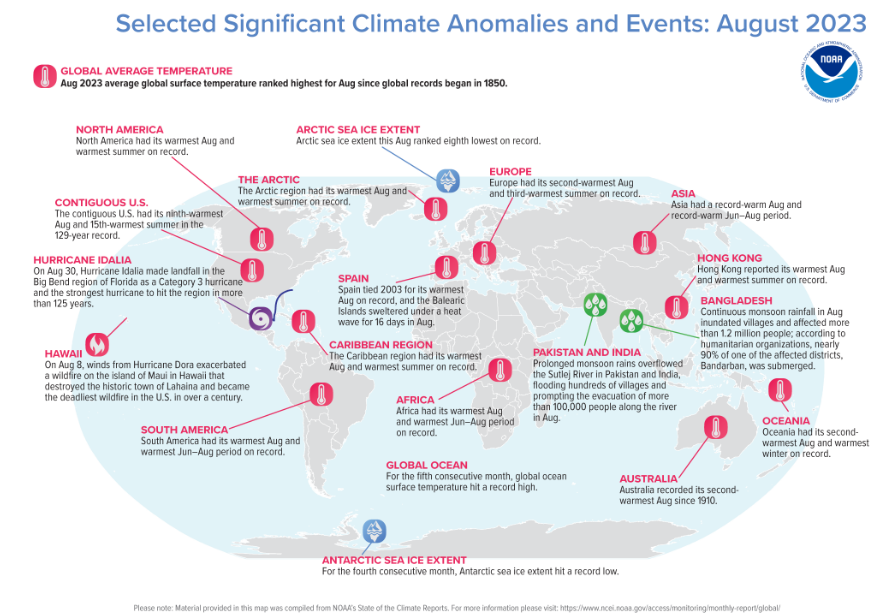
A map of the world plotted with some of the most significant climate events that occurred during August 2023. Please see the story below as well as more details in the report summary from NOAA NCEI at http://bit.ly/Global202308offsite link. (Image credit: NOAA/NCEI)
National Oceanic and Atmospheric Administration – August 2023 was Earth’s hottest August in the National Oceanic and Atmospheric Administration’s (NOAA) 174-year climate record.
The sizzling month also wrapped up the Northern Hemisphere’s warmest meteorological summer and the Southern Hemisphere’s warmest meteorological winter on record, according to an analysis by scientists from NOAA’s National Centers for Environmental Information (NCEI).
“Not only was last month the warmest August on record by quite a lot, it was also the globe’s 45th-consecutive August and the 534th-consecutive month with temperatures above the 20th-century average. Global marine heat waves and a growing El Niño are driving additional warming this year, but as long as emissions continue driving a steady march of background warming, we expect further records to be broken in the years to come,” said NOAA Chief Scientist Dr. Sarah Kapnick.
The average global land and ocean surface temperature in August was 1.25 degrees Celsius above the 20th-century average of 15.6 C, ranking as the warmest August in the 174-year global climate record.
Four continents — Africa, Asia, North America and South America — had their warmest Augusts on record, while Europe and Oceania both saw their second-warmest August on record. August 2023 was the Arctic region’s warmest August on record.
For the fifth-consecutive month, the global sea surface temperature hit a record high for the month. In fact, August 2023 set a record for the highest monthly sea surface temperature anomaly, 1.03 C higher than normal, of any month in NOAA’s climate record.
The June to August 2023 global surface temperature was 1.15 C above the 20th-century average of 15.6 C. This ranks as the warmest June to August period in the 174-year record, and 0.24 C above the previous record. The past 10 June to August periods are the 10 warmest such periods on record.
June to August 2023 was also the Northern Hemisphere’s hottest meteorological summer on record, at 1.44 C above average. The season, which also marks the Southern Hemisphere’s winter, was the Southern Hemisphere’s warmest winter on record at 0.85 C above average.
Globally, the year-to-date (YTD) ranked as the second-warmest such YTD ever recorded at 0.86 C above the 20th-century average of 14.0 C. According to NCEI’s Global Annual Temperature Outlook and data through August, there is a 95 per cent chance that 2023 will rank among the world’s two warmest years on record.
Globally, sea ice extent (coverage) in August 2023 was about 1.424 million square kilometres less than the previous record low from August 2019. Sea ice extent in Antarctica continued to track at record lows — Antarctica saw its fourth-consecutive month with the lowest sea ice extent on record. Six of the first eight months in 2023 have seen Antarctic sea ice extent at record-breaking low levels.
Nineteen named storms occurred across the globe in August 2023, which is tied for the third most for August since 1981. Eight of those reached major tropical cyclone strength (sustained winds of 179 km/h or higher), which tied August 2015 for the most August storms on record. The Atlantic, with six storms in August including two hurricanes, had activity that was considered above normal by all metrics. The East Pacific basin saw six named storms, including three major hurricanes, while the West Pacific saw seven storms, six of which became typhoons.