
Birds laying eggs earlier due to climate change
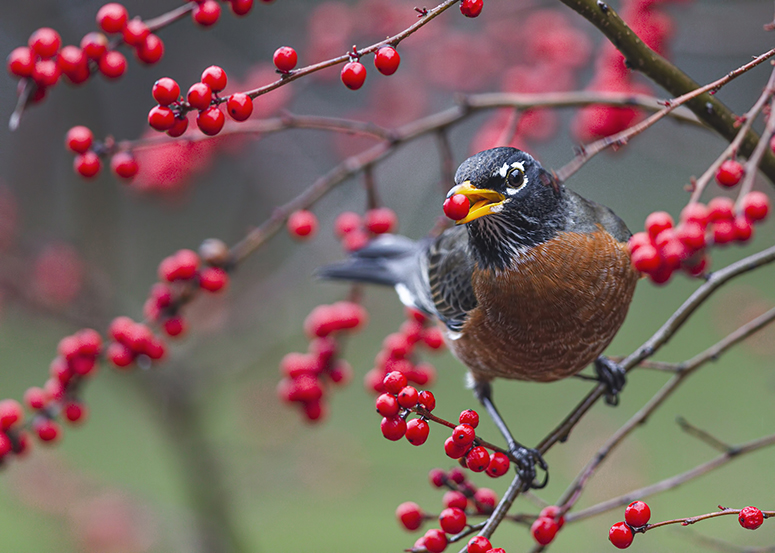
An American robin eats a winterberry. Small birds like robins typically disperse seeds over relatively short distances. (Photo by Paul Vitucci)
Field Museum – Many species of birds are nesting and laying eggs nearly a month earlier than they did a hundred years ago, according to a new study in the Journal of Animal Ecology.
By comparing recent observations with century-old eggs preserved in museum collections, scientists were able to determine that about a third of the bird species nesting in Chicago have moved their egg-laying up by an average of 25 days. And as far as the researchers can tell, the culprit in this shift is climate change.
“This paper combines these older and modern datasets to look at these trends over about 120 years and help answer really critical questions about how climate change is affecting birds,” said John Bates, curator of birds at the Field Museum and the study’s lead author.
The researchers had two big sets of nesting data: one from roughly 1880 to 1920, and another from about 1990 to 2015. Mason Fidino, a quantitative ecologist at Chicago’s Lincoln Park Zoo and a co-author of the study, built models for analyzing the data that allowed them to address the gap in the middle of the 20th century, as well as the differences in sampling between early egg collectors and modern research.
“Because of this uneven sampling, we had to share a little bit of information among species within our statistical model, which can help improve estimates a little bit for the rare species,” says Fidino. “We all realized rather quickly that there may be some outliers present in the data, and if not accounted for, could have a rather large influence on the results. Because of this, we had to build our model to reduce the overall influence of any outliers, if they were present in the data.”
The analyses showed a surprising trend: among the 72 species for which historical and modern data were available in the Chicagoland region, about a third have been nesting earlier and earlier. Among the birds whose nesting habits changed, they were laying their first eggs 25.1 days earlier than they were a hundred years ago.
The amount of carbon dioxide in the atmosphere over time neatly maps onto larger temperature trends, and the researchers found that it also correlated with the changes in egg-laying dates. “Global climate change has not been linear over this nearly 150-year period, and therefore species may not have advanced their lay date in non-linearly as well. Therefore, we included both linear and non-linear trends within our model,” says Fidino. “We found that the simulated data was very similar to the observed data, which indicated that our model did a decent job.”
The changes in temperature are seemingly small, just a few degrees, but these little changes translate to different plants blooming and insects emerging– things that could affect the food available for birds. “The majority of the birds we looked at eat insects, and insects’ seasonal behavior is also affected by climate. The birds have to move their egg-laying dates to adapt,” says Bates.
And while birds laying their eggs a few weeks early might seem like a small matter in the grand scheme of things, Bates notes that it’s part of a larger story. “The birds in our study area, upwards of 150 species, all have different evolutionary histories and different breeding biology so it’s all about the details. These changes in nesting dates might result in them competing for food and resources in a way that they didn’t used to,” he says. “There are all kinds of really important nuances that we need to know about in terms of how animals are responding to climate change.”