
CFCs declining in atmosphere
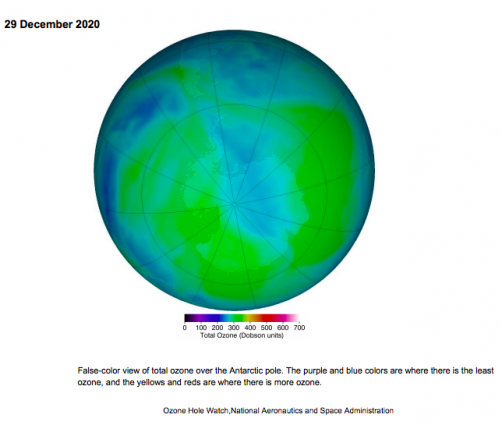
NOAA – Atmospheric concentrations of a class of ozone-depleting chemicals peaked in 2021 and are now beginning to decline as nations comply with restrictions called for by the Montreal Protocol, according to new research by current and former scientists with the United States National Oceanic and Atmospheric Administration (NOAA).
The research, led by Luke Western at the University of Bristol in England and published in Nature Climate Change, focused on a class of industrial chemicals called hydrochlorofluorocarbons (HCFCs). HCFCs were created as first-generation alternatives to more-damaging chlorofluorocarbons, or CFCs, which were responsible for creating the springtime hole in the ozone layer above Antarctica. HCFCs also deplete ozone and trap heat in the atmosphere, but to a lesser degree than the CFCs they replace.
Western said the results underscore the value of establishing and following international agreements like the Montreal Protocol on substances that deplete the ozone layer.
“Without the Montreal Protocol, this success would not have been possible, so it’s a resounding endorsement of multilateral commitments to combat the impacts of human-induced climate change,” said Western, who initiated this work while he was a research fellow with NOAA’s Global Monitoring Laboratory.
Using high-precision measurements of air samples provided by NOAA’s Global Greenhouse Gas Reference Network and the Advanced Global Atmospheric Gases Experiment obtained at their globally distributed atmospheric observatories, the researchers were able to determine that both the ozone-depleting impact and heat-trapping impact of HCFCs had peaked five years earlier than projections.
Agreed to in 1987, the Montreal Protocol is a multilateral environmental agreement that introduced controls on the production of ozone-depleting substances like CFCs. CFCs were once widely used in the manufacture of hundreds of products, including aerosol sprays, cooling devices, blowing agents for foams and packaging, and solvents.
Scientists expect adherence to controls agreed to by the parties to the Montreal Protocol will restore the stratospheric ozone layer by 2065, preventing 443 million cases of skin cancer, approximately 2.3 million skin cancer deaths, and more than 63 million cases of cataracts in the United States alone, with even greater benefits worldwide.
Once HCFCs leak to the atmosphere, they are vastly more efficient than an equal amount of CO2 at trapping heat in Earth’s atmosphere that would otherwise escape into space. The warming from a release of the most commonly used HCFC over 100 years is nearly 2,000 times larger than from an equivalent amount of CO2.
In September 2007, the parties to the Montreal Protocol decided to accelerate their schedule to phase out production of HCFCs for use in applications that account for most of the releases to the atmosphere. Developed countries completely phased them out by 2020. Developing countries agreed to start their phase-out process in 2013 and with a complete phase-out of HCFCs targeted by 2030.