Climate action urgent in Africa: report
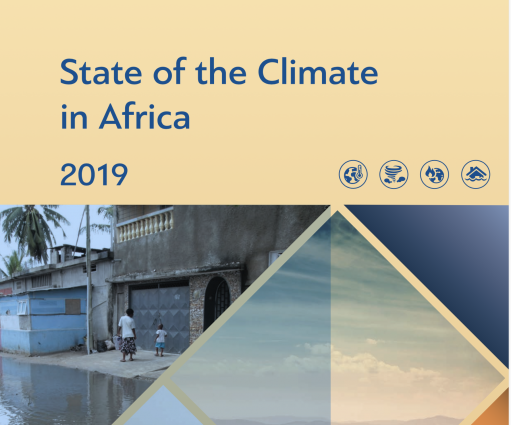
 WMO – Increasing temperatures and sea levels, changing precipitation patterns and more extreme weather are threatening human health and safety, food and water security and socio-economic development in Africa, according to a new State of the Climate in Africa 2019 report from the World Meteorological Organization (WMO) released Oct. 26.
“Climate change is having a growing impact on the African continent, hitting the most vulnerable hardest, and contributing to food insecurity, population displacement and stress on water resources. In recent months we have seen devastating floods, an invasion of desert locusts and now face the looming spectre of drought because of a La Niña event. The human and economic toll has been aggravated by the COVID-19 pandemic,” said WMO Secretary-General Petteri Taalas in a news release.
“Science-based climate information is the foundation of resilience building, a cornerstone of climate change adaptation, as well as an oasis for sustainable livelihoods and development. The State of Climate Report for Africa has, therefore, a critical role to play in this respect, including in informing our actions for achieving the goals of the Africa Agenda 2063,” added H.E. Josefa Leonel Correia Sacko, Commissioner for Rural Economy and Agriculture of the African Union Commission in the news release.
“The limited uptake and use of climate information services in development planning and practice in Africa is due in part to the paucity of reliable and timely climate information. This report, focusing on Africa, will go a long way towards addressing this gap. The contribution of the Economic Commission for Africa to the production of this report, through the African Climate Policy Centre, seeks to highlight the nexus between climate change and development, and to emphasise that building forward better from the Covid-19 pandemic requires a development approach that is green, sustainable and climate resilient, informed by the best available science. The participation of multiple institutions and agencies in producing the report reinforces our principles and approaches of working as one,” said H.E. Vera Songwe, Under-Secretary-General and Executive Secretary of the United Nations Economic Commission for Africa.
The year 2019 was among the three warmest years on record for the continent. That trend is expected to continue. African temperatures in recent decades have been warming at a rate comparable to that of most other continents, and thus somewhat faster than global mean surface temperature.
The latest decadal predictions, covering the five-year period from 2020 to 2024, shows continued warming and decreasing rainfall especially over North and Southern Africa, and increased rainfall over the Sahel.
Extensive areas of Africa will exceed 2 °C of warming above pre-industrial levels by the last two decades of this century under medium scenarios as reported in the Intergovernmental Panel on Climate Change Fifth Assessment Report. Much of Africa has already warmed by more than 1 °C since 1901, with an increase in heatwaves and hot days. A reduction in precipitation is likely over North Africa and the south-western parts of South Africa by the end of the century, according to the IPCC.
Food security impacts
Rising sea levels, coastal degradation, extreme weather events, droughts, and floods all contributed to food security concerns in the continent.
In the drought-prone sub-Saharan African countries, the number of undernourished people has increased by 45.6% since 2012 according to the Food and Agriculture Organization of the United Nations (FAO).
Agriculture is the backbone of Africa’s economy and accounts for the majority of livelihoods across the continent. Africa is therefore an exposure and vulnerability “hot spot” for climate variability and change impacts.
IPCC projections suggest that warming scenarios risk having devastating effects on crop production and food security.
Key risks to agriculture include reduced crop productivity associated with heat and drought stress and increased pest damage, disease damage and flood impacts on food system infrastructure, resulting in serious adverse effects on food security and on livelihoods at the regional, national and individual household levels.
Health impacts
Increases in temperature and changes in rainfall patterns also significantly affect population health across Africa. Warmer temperatures and higher rainfall increase habitat suitability for biting insects and the transmission of vector-borne diseases such as dengue fever, malaria and yellow fever. In addition, new diseases are emerging in regions where they were previously not present.
Economic impacts
Adverse consequences of climate change are concentrated in regions with relatively hot climates, where a disproportionately large number of low-income countries are located, according to the International Monetary Fund (IMF).
The African Climate Policy Centre projects that the Gross Domestic Product in the five African subregions would suffer significant decrease as a result of a global temperature increase.
Climate Action
Africa’s Agenda 2063, which was concluded in 2013, recognizes climate change as a major challenge for the continent’s development.
Africa and the small island developing States are the regions facing the largest capacity gaps with regard to climate services. Africa also has the least developed land-based observation network of all continents.