Conflict, climate change and public health
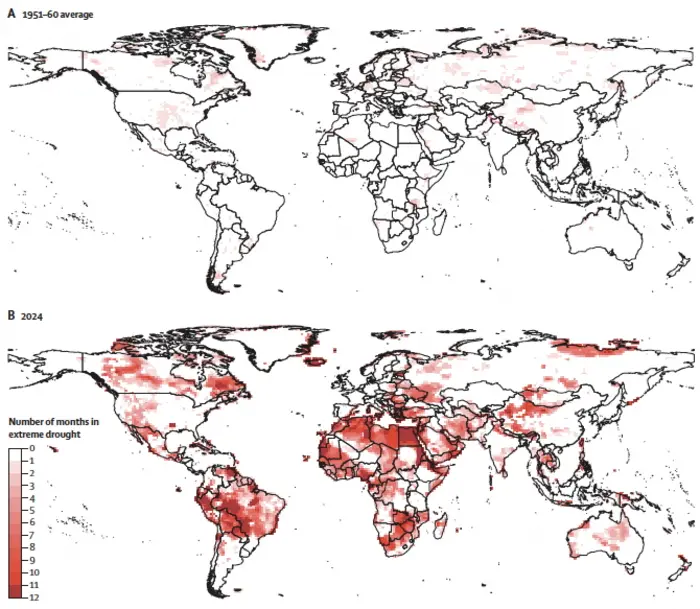
Annual number of months of extreme drought on average in 1951-1960(A) and 2024(B). Lancet Countdown 2025
University of Utah (WeatherFarm) — The Lancet Countdown, an annual indicator report led by University College London and produced in strategic partnership with the World Health Organization (WHO), was released Oct. 29. It’s the ninth 2025 global report of the Lancet on health and climate change, representing the work of 128 leading experts from 71 academic institutions and United Nations agencies globally.
The report provides the most comprehensive assessment to date of the connections between climate change and health, including new metrics which record deaths from extreme heat and wildfire smoke, the coverage of urban blue spaces (rivers, lakes and coastlines), health adaptation funding and individual engagement with health and climate change.
Prof. Andrew Linke of the School of Environment, Society & Sustainability at the University of Utah, co-authored a section of the study focused on how climate change and health intersect with armed conflict.
“It isn’t that the adverse effects of climate change cause violence directly, it’s that climate change is one part of a constellation of factors that contribute to cycles of political instability with impacts upon the provision of or access to healthcare,” Linke said.
Rural and primarily agricultural economies are the most susceptible to climate change and armed conflict, he continued. Structural conditions, including poverty, inequality and weak governance, make for a potentially volatile society. Climate change adds pressure to an already fragile system with extreme heat, drought, flooding and shifting precipitation patterns, reducing crop yields and raising food prices while lowering household incomes and disrupting livelihoods. These stressors affect the socioeconomic conditions on which health depends, especially in ethnically divided or areas with scarce resources.
The Lancet Countdown’s principal authors invited Linke to join the project last year after his talk at the Johns Hopkins University Bloomberg School of Public Health. Linke’s presentation focused on local-level population exposure to violent events worldwide, which can damage infrastructure like schools or healthcare facilities and reduce economic opportunities for communities.
“They thought my perspective could fill in a missing piece of the puzzle. Most of the Lancet Countdown explores how climate change influences population health directly due to things like mosquito-borne illness or extreme heat,” Linke said. “My contribution was more on the indirect effects of armed conflict and political instability amid climate change—what does population health look like with flood-damaged health clinics, disrupted transportation or disease exposure in refugee camps, for example?”
Managing social and economic changes is key to preventing climate-related conflict, the study concluded. Strengthening food systems boosts resilience, which can reduce malnutrition and food insecurity. If extreme weather events disrupt supply chains, ensuring emergency responses help all communities equally can lessen grievances and protect health care workers that often targeted when healthcare is limited.
The report concludes in an optimistic tone: “In a time of growing geopolitical volatility, strengthening multilateral co-operation and ensuring that the transition is not only green but also just might be essential to building peace in a climate-affected world.”