
Domino effect in Amazon region
Adaptivity threatened by global warming, deforestation
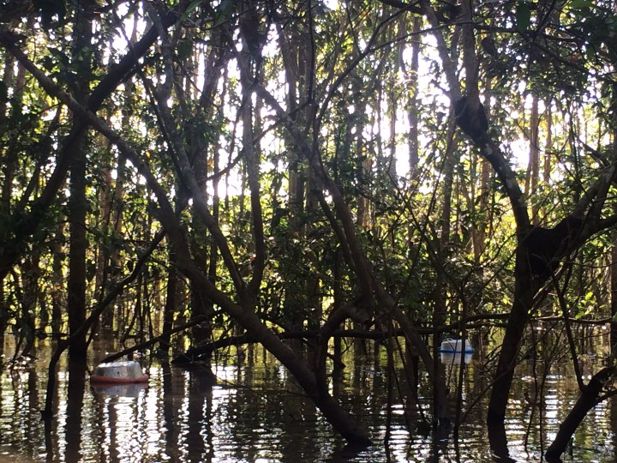
Trees in the Amazon river basin. (Photo credit: Viviane Figueiredo Souza)
Center for Marine Environment Sciences, University of Bremen (WeatherFarm) – The Earth’s climate system is highly complex and its components are closely interlinked. Changes in individual parameters can have far-reaching effects on the entire system. To a certain extent, the components of the system are resilient and can absorb changes.
Climate and Earth-system research assumes there are various tipping points. If these are exceeded, the climate system can change within a short period of time. It’s also presumed these tipping points in the climate system influence each other and can trigger chain reactions.
Two tipping points are the Amazon rainforest and the large-scale Atlantic Meridional Overturning Circulation (AMOC). Further warming of the planet can lead to a significant weakening of the AMOC. This would slow down the conveyor belt carrying warm water to the northern regions, drastically changing the temperature distribution in the Atlantic and have consequences for the Amazon region because the altered temperatures in the Atlantic would affect the atmospheric water cycle, and the patterns and amounts of precipitation.
Exactly how the AMOC and the Amazon are interconnected as systems, and how marine circulation affects the Amazon region, have not yet been extensively researched. A group of international researchers have now analyzed changes in the vegetation of the Amazon region, such as pollen and carbon residues representing the past 25,000 years from a marine sediment core taken from the mouth of the Amazon River.
This provided them with a detailed glimpse into the past of one of the most species-rich ecosystems on Earth. The data showed how the vegetation changed during the climate events of the last ice age, called Heinrich Events, when the AMOC was drastically weakened. The researchers found a dramatic decline in rainforest vegetation in the Amazon’s northern region.
“Our data shows the Amazon ecosystem was able to adapt in the past to changes in the patterns of precipitation that resulted from weakened Atlantic circulation. But a weakening of the AMOC in the future occurring simultaneously with an increase in deforestation could threaten the stability of this important global system,” said Stefan Mulitza of the Center for Marine Environment Sciences, University of Bremen (MARUM).
Further studies employing climate and vegetation models indicated a weakening of the AMOC under present-day conditions would have an effect on Amazon vegetation similar to that which it had during the past ice age.
“The models have shown us that the AMOC need not completely collapse in order to have an effect on the rainforest. The northern areas of the Amazon region are massively impacted under mere moderate changes in the AMOC,” explained MARUM’s Matthias Prange.
“Driving processes at high latitudes, like the melting of Greenland ice, can have a substantial effect on the tropics. Such long-distance influences often have severe regional effects, very often for people who are only minimally responsible for causing climate change,” added University of Bremen’s Gerrit Lohmann.