Drought severity varied in Western Canada
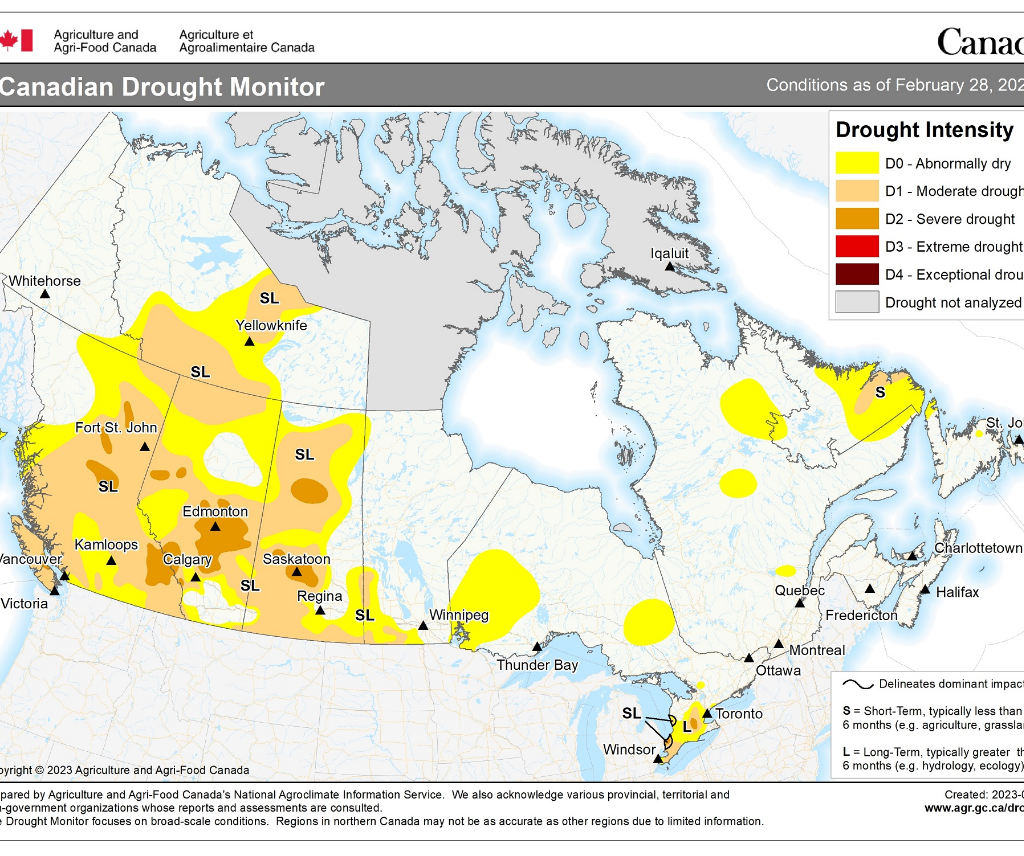
Drought conditions across Canada as of Feb. 28, 2023. Photo credit: Agriculture and Agri-Food Canada.
WINNIPEG – While parts of the western Prairies received above-normal precipitation in February which eased drought concerns, the eastern Prairies were not as fortunate, according to Agriculture and Agri-Food Canada’s (AAFC) Canadian Drought Monitor (CDM).
While there were no longer any areas classified under Extreme (D3) or Exceptional Drought (D4), 60 per cent of the Prairies was classified as Abnormally Dry (D0) or in Moderate (D1) to Severe Drought (D2), including 78 per cent of the region’s farmland, as of Feb. 28.
Cooler temperatures descended onto the Prairies in February, while increased precipitation in the Rockies added onto the snowpack and improved the area within Banff National Park from D3 to D2. This winter, southern and eastern Alberta, along with western and central Saskatchewan, received near- or above-normal amounts of snowfall. Parts of southern Saskatchewan, as well as areas around Brooks, Alta. and Cree Lake, Sask. in the north, were upgraded from D1 to D0.
However, below-normal precipitation was received in southeastern Saskatchewan and much of Manitoba, causing drought conditions to expand unlike in the rest of the country. Dry conditions over the last three to six months in southern and southwestern Manitoba caused a small expansion of area under D0 and D1. CDM’s monthly report also said many parts of the Prairies “would benefit from continued precipitation in order to make up for the well below-normal soil moisture reserves and depleted surface water supplies in the fall.”
The Pacific Region (British Columbia) was the worst drought-affected region with 83 per cent considered D0 or worse, including nearly 100 per cent of farmland. In Canada, 37 per cent of land was considered D0 or worse, including 62 per cent of farmland.