
Earth-sun distance alters dramatically
22,000-year cycle boosts or diminishes pacific cold tongue
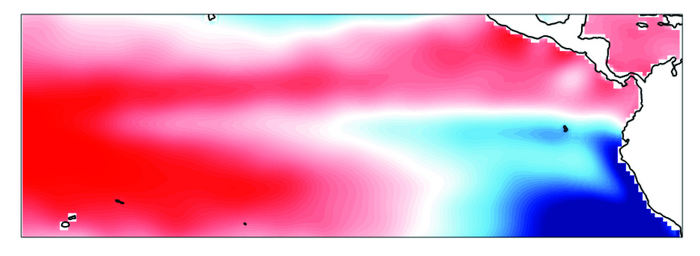
The pacific cold tongue protruding westward from the North American west coast.
University of California, Berkeley (WeatherFarm) – Weather and climate modelers understand pretty well how seasonal winds and ocean currents affect El Niño patterns in the eastern equatorial Pacific Ocean, impacting weather across the United States and sometimes worldwide.
But new computer simulations show that one driver of annual weather cycles in that region — in particular, a cold tongue of surface waters stretching westward along the equator from the coast of South America — has gone unrecognized: the changing distance between Earth and the sun.
The cold tongue, in turn, influences the El Niño-Southern Oscillation (ENSO), which impacts weather in California, much of North America, and often globally.
The Earth-sun distance slowly varies over the course of the year because Earth’s orbit is slightly elliptical. Currently, at its closest approach — perihelion — Earth is about three million miles closer to the sun than at its farthest point, or aphelion. As a result, sunlight is about seven per cent more intense at perihelion than at aphelion.
Research led by the University of California, Berkeley, demonstrates that the slight yearly change in our distance from the sun can have a large effect on the annual cycle of the cold tongue. This is distinct from the effect of Earth’s axial tilt on the seasons, which is currently understood to cause the annual cycle of the cold tongue.
Because the period of the annual cycle arising from the tilt and distance effects are slightly different, their combined effects vary over time, said lead researcher John Chiang, UC Berkeley professor of geography.
“The curious thing is that the annual cycle from the distance effect is slightly longer than that for tilt — around 25 minutes, currently — so over a span of about 11,000 years, the two annual cycles go from being in phase to out of phase, and the net seasonality undergoes a remarkable change, as a result,” he said.
Chiang noted that the distance effect is already incorporated into climate models — though its effect on the equatorial Pacific was not recognized until now — and his findings will not alter weather predictions or climate projections. But the 22,000-year phase cycle may have had long-term, historical effects. Earth’s orbital precession is known to have affected the timing of the ice ages, for example.
The distance effect — and its 22,000-year variation — also may affect other weather systems on Earth. The ENSO, which also originates in the equatorial Pacific, is likely affected because its workings are closely tied to the seasonal cycle of the cold tongue.
“Theory tells us that the seasonal cycle of the cold tongue plays a key role in the development and termination of ENSO events. Because of this, many of ENSO’s key characteristics are synced to the seasonal cycle,” said Alyssa Atwood, assistant professor at Florida State University in Tallahassee.
For example, ENSO events tend to peak during Northern Hemisphere winters, she said, and they don’t typically persist beyond northern or boreal spring months, which scientists refer to as the “spring predictability barrier.” Because of these linkages, it is reasonable to expect that the distance effect could also have a major impact on ENSO — something that should be examined in future studies.
“Very little attention has been paid to the cold tongue seasonal cycle because most people think it’s solved. There’s nothing interesting there,” Chiang commented. “What this research shows is that it’s not solved. There’s still a mystery there. Our result also begs the question whether other regions on Earth may also have a significant distance effect contribution to their seasonal cycle.”
“We learn in science classes as early as grade school that the seasons are caused by the tilt of Earth’s axis,” added co-author Anthony Broccoli of Rutgers University. “This is certainly true and has been well understood for centuries. Although the effect of the Earth-sun distance has also been recognized, our study indicates that this ‘distance effect’ may be a more important effect on climate than had been recognized previously.”
Chiang, Atwood and Broccoli and their colleagues reported their findings today in the journal Nature.