
Faster Arctic warming hastens 2 C rise by eight years: study
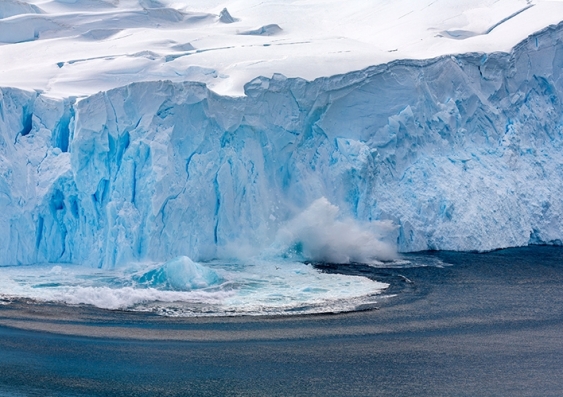
Scientists fear the retreat of the Antarctic ice sheet has already passed a critical tipping point that will inevitably lead to sea level rise over the coming centuries. Photo: Shutterstock
University College London – Faster warming in the Arctic will be responsible for a global two-degree Celsius temperature rise being reached eight years earlier than if the region was warming at the average global rate, according to a new modelling study led by University College London (UCL) researchers.
The Arctic is currently warming nearly four times faster than the global average rate. The new study, published in the journal Earth System Dynamics, aimed to estimate the impact of this faster warming on how quickly the global temperature thresholds of 1.5 C and 2 C, set down in the Paris Agreement, are likely to be breached.
To do this, the research team created alternative climate change projections in which rapid Arctic warming was not occurring. They then compared temperatures in this hypothetical world with those of the “real-world” models and examined the timing with which the critical Paris Agreement thresholds of 1.5 C and 2 C were breached. They found that, in the models without fast Arctic warming, the thresholds were breached five and eight years later respectively, than their “real-world” projected dates of 2031 and 2051.
In addition, they found that disproportionately fast Arctic warming, known as Arctic amplification, added disproportionate uncertainty to forecasts, as the variation in model projections for the region is larger than for the rest of the planet.
Alistair Duffey from UCL Earth Sciences, a PhD candidate and lead author of the study, said, “Our study highlights the global importance of rapid Arctic warming by quantifying its large impact on when we are likely to breach critical climate thresholds. Arctic warming also adds substantial uncertainty to climate forecasts.
“These findings underscore the need for more extensive monitoring of temperatures in the region, both in-situ and via satellites, and for a better understanding of the processes occurring there, which can be used to improve forecasts of global temperature rise.”
The study does not attempt to quantify the ways in which Arctic warming affects the rest of the world, for instance through the retreat of sea ice which helps to keep the planet cool, but instead estimates the direct contribution of Arctic warming to global temperature increases.
Co-author Professor Julienne Stroeve from UCL Earth Sciences, the University of Manitoba, and the U.S. National Snow and Ice Data Center said, “While our study focuses on how Arctic warming affects global temperature change, the local impacts should not be overlooked. A 2 C temperature rise globally would result in a 4 C annual mean rise in the Arctic, and a 7 C rise in winter, with profound consequences for local people and ecosystems.
“In addition, rapid warming in the Arctic has global consequences that we do not account for in this study, including sea level rise and the thawing of permafrost which leads to more carbon being released into the air.”
Co-author Dr. Robbie Mallett from the University of Manitoba and Honorary Research Fellow at UCL Earth Sciences said, “Arctic climate change is often overlooked by politicians because most of the region is outside national boundaries. Our study shows how much the Arctic impacts global targets like the Paris Agreement, and hopefully draws attention to the crisis that’s already unfolding in the region.”
The goal of the Paris Agreement, an international treaty, is to keep the global average temperature to “well below 2 C above pre-industrial levels” and pursue efforts “to limit the temperature increase to 1.5 C”.
The Arctic is thought to have warmed by 2.7 C since the pre-industrial era, and this warming is believed to have accelerated since the start of the 21st century.