
February 2023 fourth-warmest on record: NOAA
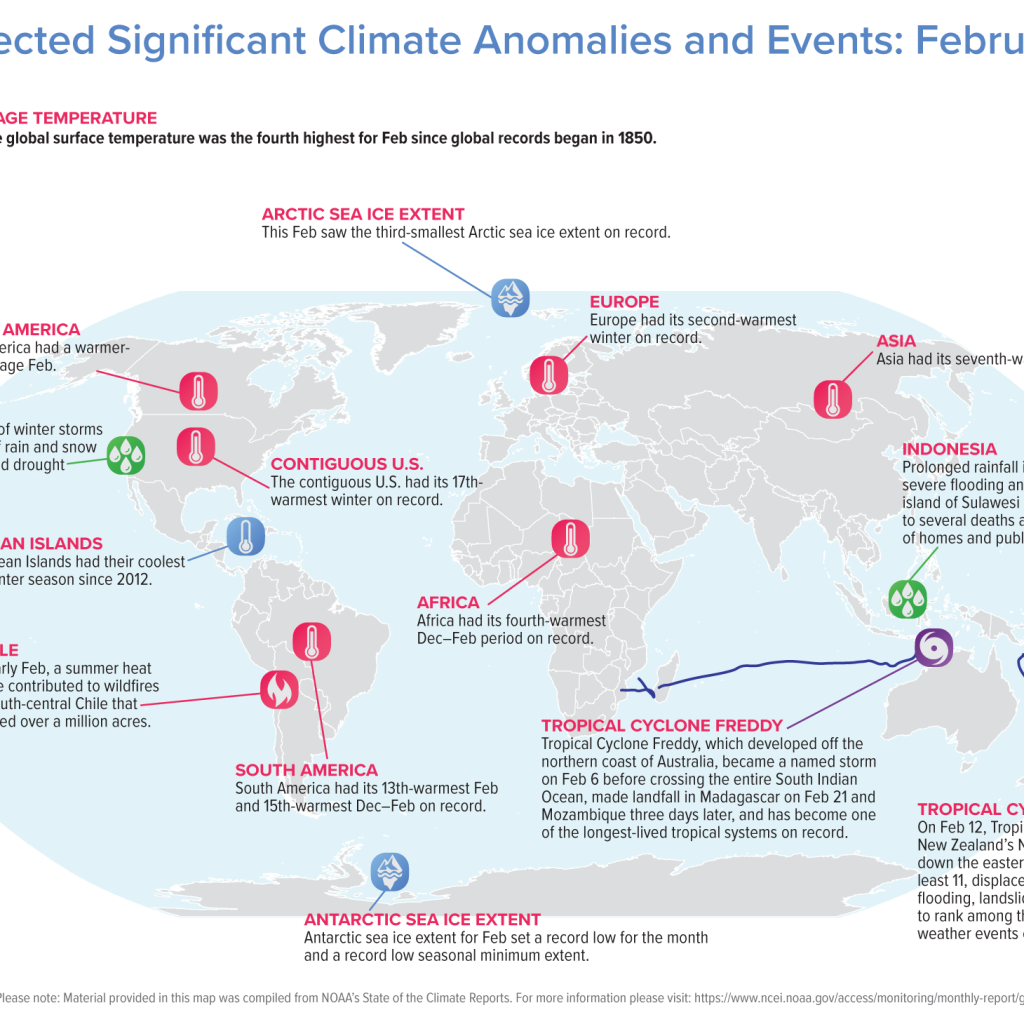
A map of the world plotted with some of the most significant climate events that occurred during February 2023. (Image credit: NOAA NCEI)
NOAA – The warm start to 2023 continued with last month ranking as the world’s fourth-warmest February in 174 years, according to the National Oceanic and Atmospheric Administration (NOAA).
Last month also wrapped up a very warm December to February season for the planet as global sea ice set a record low for February, according to scientists from NOAA’s National Centers for Environmental Information (NCEI).
The February global land and ocean surface temperature was 0.97 of a degree Celsius above the 20th-century average of 12.1 degrees C, ranking as the fourth-warmest February in the global climate record. Also, this ranks as the fifth-warmest December-through-February period in the global climate record, tied with 2018 and 2022.
February 2023 marked the 44th-consecutive February and the 528th-consecutive month with temperatures above the 20th-century average.
Regionally, Asia had its seventh-warmest February on record, while South America, Europe and Africa all saw a top-20 warm February. North America and Oceania both had a warmer-than-average February, although temperatures did not rank among the top-20 warmest.
The past nine December–through-February seasons have ranked among the 10 warmest such periods on record.
December 2022 to February 2023 was also the Northern Hemisphere’s fifth-warmest meteorological winter and the Southern Hemisphere’s 10th-warmest meteorological summer on record, tied with 2003 and 2006.
Europe had its second-warmest meteorological winter on record (behind winter of 2019-2020) while Africa — which straddles the equator — saw its fourth-warmest December–through-February period.
Globally, February 2023 set a record for the lowest February sea ice extent (coverage) on record. Antarctic sea ice extent ranked lowest on record at 460,000 square miles below the 1991 to 2020 average as Arctic sea ice extent was about 260,000 square miles below the 1991 to 2020 average, ranking as the third-smallest February extent in the 45-year record. Five named storms occurred across the globe in February 2023. Four of those reached tropical cyclone strength (winds of 119 kilometres per hour or higher) and one reached major tropical cyclone strength (winds of 179 km/h or higher). The number of tropical cyclones was above the 1991 to 2020 normal of 3.5 storms for February.
The global accumulated cyclone energy (called ACE, a metric that indicates the amount of energy released by a tropical cyclone during its lifetime) was nearly twice the normal value and the second highest on record since 1972. The exceptionally long-lived Tropical Cyclone Freddy in the South Indian Ocean was responsible for about 75 per cent of the ACE in February.