
February 2025 third-warmest on record
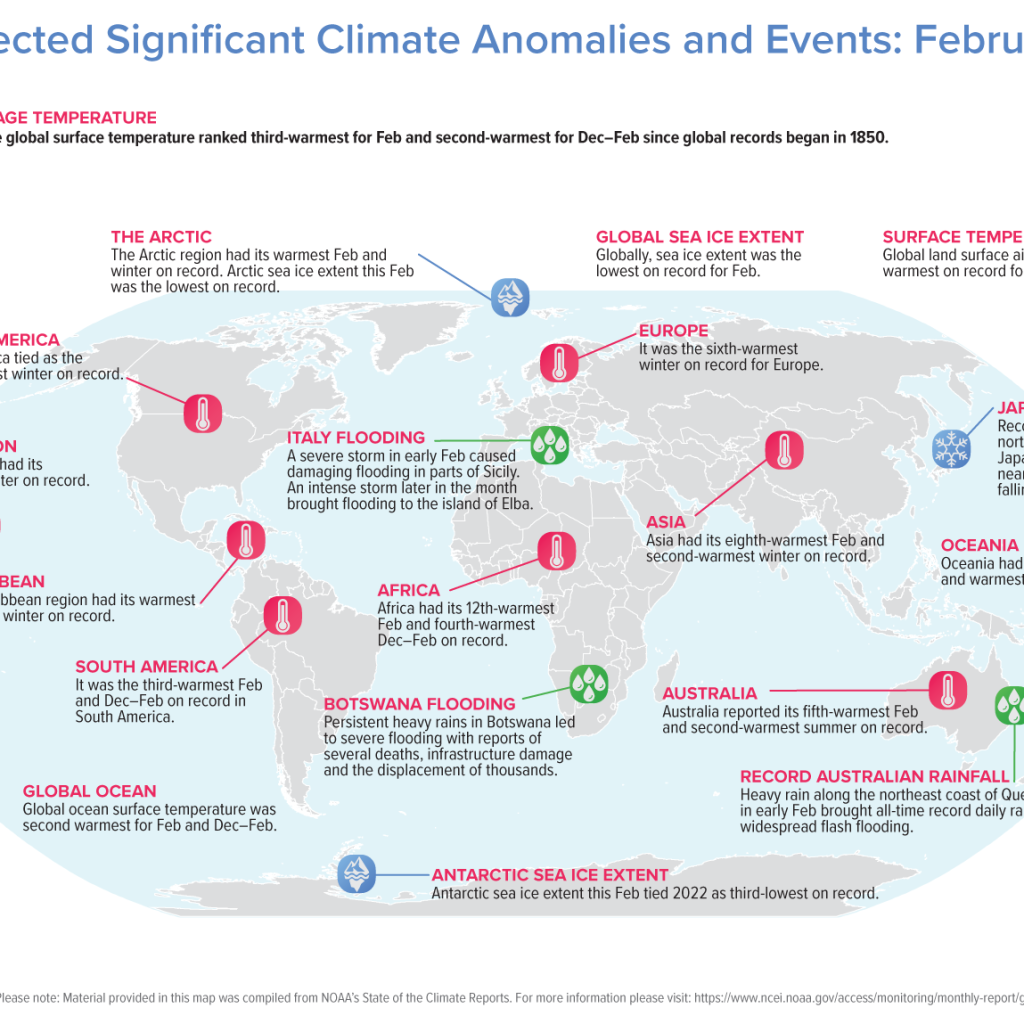
Credit: NOAA/NCEI
NOAA – The United States National Oceanic and Atmospheric Administration reported that last month was the third-warmest February on record, while global sea ice extent was the lowest ever.
The February global surface temperature was 1.26 degrees Celsius above the 20th-century average of 12.1 C, making it the third-warmest February on record. The National Centers for Environmental Information’s Global Annual Temperature Outlook predicted there is a four per cent chance that 2025 will rank as the warmest year on record.
It was the fourth-warmest February for the global land air temperature and the second-warmest February for the global ocean surface temperature. Global temperatures have cooled in recent months as a La Niña episode, the cold phase of El Niño Southern Oscillation (ENSO), developed. Global temperatures tend to be cooler during periods of La Niña in comparison to periods with an El Niño present.
February temperatures were above average across much of the global land surface, particularly over the Arctic, central Eurasia, southern South America and central Australia. Much of western Canada, the central United States, eastern Europe, the Middle East and China were colder than average. Sea surface temperatures were above average over most areas, while much of the central and eastern tropical Pacific was below average (consistent with La Niña), as were parts of the southeast Pacific, western North Atlantic and the northwestern Indian Oceans.
The Northern Hemisphere snow cover extent in February was slightly below average. Snow cover over North America and Greenland was below average (by 129,500 square kilometres), and Eurasia was also below average (by 103,600 sq. km.) Areas of below-average snow cover include the central United States and much of Europe.
Global sea ice extent was the smallest in the 47-year record at 15.95 million sq. km., which was 1.99 million below the 1991 to 2020 average. Arctic sea ice extent was below average (by 1.11 million sq. km.), ranking lowest on record, and Antarctic extent was below average (by 880,600 sq. km.), tied with 2022 for third-lowest on record.
Twelve named storms occurred across the globe in February, which set an all-time record for the month. A record five named storms occurred in the southwestern Indian Ocean. Five named storms occurred in the Australian region, as well as four in the southwest Pacific.