Global dust levels rise: WMO report
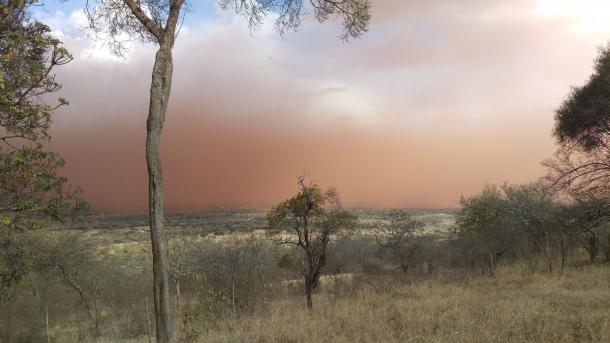
WMO – Global dust levels were up slightly in 2022 compared to the previous year, according the annual report on the incidence and hazards of sand and dust storms released by the World Meteorological Organization (WMO) on Oct. 19.
Increased emissions from west-central Africa, the Arabian Peninsula, the Iranian Plateau and north-western China accounted for the rise in the global average. Spatially, the estimated peak annual mean dust surface concentration was in the Bodéle region of Chad in Africa, according to the Airborne Dust Bulletin 2022.
In 2022, hotspots with significantly higher dust concentrations were identified in Central and South America, most of Central Africa, Spain, the Red Sea, the Arabian Peninsula, the Arabian Sea, the Iranian Plateau, the Bay of Bengal, South Asia, the Tarim Basin in north-west China and the tropical Atlantic Ocean between West Africa and the Caribbean.
Every year, around two billion tonnes of dust enters the atmosphere, darkening skies and harming air quality in regions that can be thousands of kilometres away – affecting economies, ecosystems, weather and climate. Much of this is a natural process, but a large part of it is also the result of poor water and land management.
Monitoring and forecasting accuracy has improved in recent years due to the progress of numerical models and observation systems. The WMO Sand and Dust Storm Warning Advisory and Assessment System (SDS-WAS), set up in 2007, strives to improve warnings through dedicated regional centres and combines research and operational work which is now being embedded in the international Early Warnings for All initiative.
“WMO is committed to tackling this major hazard. Sand and dust storms have impacts on health, on transport including aviation, ground transportation, road and railroad transportation and agriculture. This affects public health and safety and economies,” said WMO Secretary-General Prof. Petteri Taalas.
“The Early Warnings for All initiative contains an ambition to improve standard dust storm forecasting skills and warning services. We very promoting multi-hazard early warning service concepts to bring all hazards under one umbrella. And we also promoting impact-based forecasting which lies at the heart of improved warnings for sand and dust storms,” added Taalas.
However, the WMO cautioned that more needs to be done, especially in the face of continuing environmental degradation and current and future climate change.
“The reports from the Intergovernmental Panel on Climate Change and WMO’s State of the Climate reports show that human activities are having an impact on sand and dust storms. For example higher temperatures, drought and higher evaporation lead to lower soil moisture. Combined with poor land management, this is conducive to more sand and dust storms,” said Taalas.
Dust storms impact aviation and road transport; they reduce the performance of solar power plants and spread human pathogens, all of which negatively affect local and regional economies. The loss of soil nutrients costs agriculture more than US$8 billion dollars every year in the Pan-American region.
Exposure to dust particles has been associated with adverse health effects, including heart attacks, cardiovascular mortality, lung cancer and other sicknesses.
The Airborne Dust Bulletin highlights the need for further research into future interactions between sand and dust storms and climate change as well as accompanying changes in the global atmospheric circulation and precipitation patterns.