
Global warming increasing at ‘steady’ rate: study
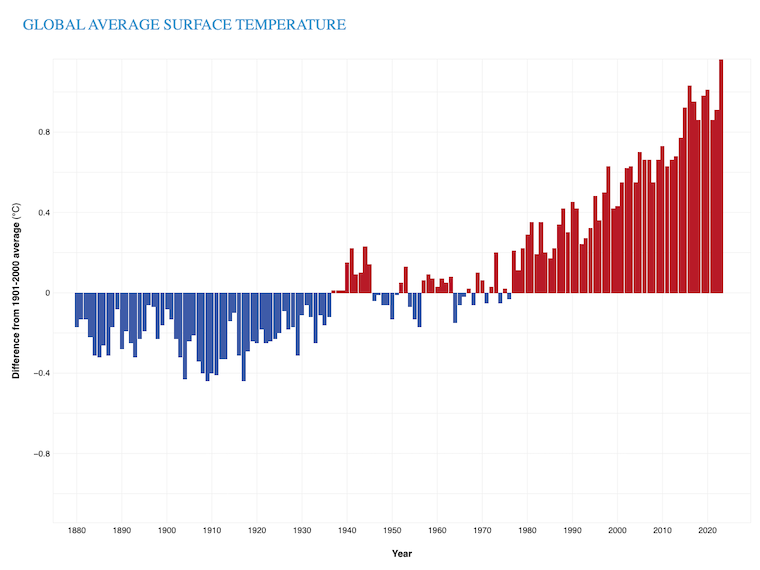
Yearly surface temperature from 1880 to 2023, compared to the 20th-century average (1901-2000). Blue bars indicate cooler-than-average years; red bars show warmer-than-average years. (Credit: NOAA Climate.gov)
University of California, Santa Cruz – An international team of researchers led by scientists at the University of California, Santa Cruz investigated if the rate of global warming has increased significantly, or “surged,” over the last half century at statistically detectable rates.
The new study, published in the journal Nature Communications Earth & Environment on Oct. 14, confirms the broad consensus that the planet is getting warmer, but at a statistically steady rate, not at a sufficiently accelerated rate that could be statistically defined as a surge.
Data show 2023 was the warmest year since global records began in 1850 by a wide margin and that the 10 warmest years in the historical record have all occurred in 2014 to 2023.
However, the team’s findings demonstrate a lack of statistical evidence for an increased warming rate that could be defined as a surge.
“We’ve had these record-breaking temperatures recently. But that’s not necessarily inconsistent with steadily increasing global warming,” said lead author Claudie Beaulieu, professor of ocean sciences at UC Santa Cruz. “Of course, it is still possible that an acceleration in global warming is occurring. But we found that the magnitude of the acceleration is either statistically too small, or there isn’t enough data yet to robustly detect it.”
The research team performed a rigorous analysis of sets of global surface-temperature averages from the four main agencies that track the average temperature of Earth’s surface, including NASA and the National Oceanic and Atmospheric Association (NOAA) dating back to 1850. Since that year, Earth’s temperature has risen by 0.11 degrees Fahrenheit (0.06 degrees Celsius) per decade, according to NOAA.
Their analysis deemed an increased warming surge to be statistically detectable if it exceeded and sustained a level above those temporary fluctuations over a long period of time. After accounting for short-term average temperature fluctuations, which can mask long-term trends and create the appearance of slowdowns and surges in warming, and using a range of statistical methods, the team determined the level of increased warming that would be needed for a given number of years in order to detect surges.
Although their findings show no statistical evidence that we are in the midst of a warming surge, Beaulieu emphasized that they aren’t refuting the reality of climate change.
“Earth is the warmest it has ever been since the start of the instrumental record because of human activities—and to be clear, our analysis demonstrates the ongoing warming,” Beaulieu said. “However, if there’s an acceleration in global warming, we can’t statistically detect it yet.”