
Greenhouse gases hit record highs: WMO
WMO – Greenhouse gases in the atmosphere rose to record high levels in 2020, according to the annual Greenhouse Gas Bulletin from the World Meteorological Organization. The report was released ahead of the United Nations Climate Change Conference of the Parties (COP26) taking place in Glasgow Oct. 31 to Nov. 12.
Concentration of carbon dioxide (CO2) reached 413.2 parts per million in 2020 and is 149 per cent of the pre-industrial level. Methane (CH4) is 262 per cent and nitrous oxide (N2O) is 123 per cent of the levels in 1750 when human activities started disrupting Earth’s natural equilibrium. The economic slowdown from COVID-19 did not have any discernible impact on the atmospheric levels of greenhouse gases and their growth rates, although there was a temporary decline in new emissions, said the report.
As long as emissions continue, global temperature will continue to rise, said the WMO. Given the long life of CO2, the temperature level already observed will persist for several decades even if emissions are rapidly reduced to net zero. Alongside rising temperatures, this means more weather extremes including intense heat and rainfall, ice melt, sea-level rise and ocean acidification, accompanied by far-reaching socioeconomic impacts.
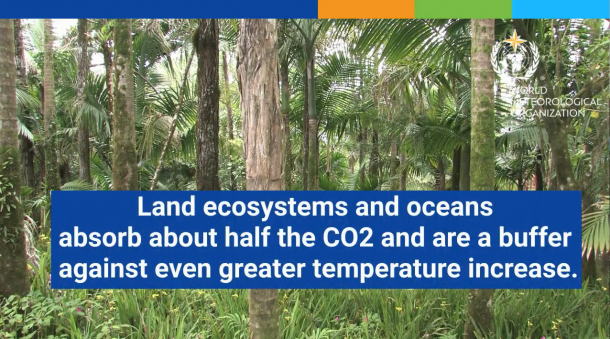
Roughly half of the CO2 emitted by human activities today remains in the atmosphere. The other half is taken up by oceans and land ecosystems. The Bulletin flagged concern that the ability of land ecosystems and oceans to act as “sinks” may become less effective in future, thus reducing their ability to absorb carbon dioxide and act as a buffer against larger temperature increase.
From 1990 to 2020, the warming effect on our climate by long-lived greenhouse gases increased by 47 per cent, with CO2 accounting for about 80 per cent of this increase. The numbers are based on monitoring by WMO’s Global Atmosphere Watch network.
“The Greenhouse Gas Bulletin contains a stark, scientific message for climate change negotiators at COP26. At the current rate of increase in greenhouse gas concentrations, we will see a temperature increase by the end of this century far in excess of the Paris Agreement targets of 1.5 to two degrees Celsius above pre-industrial levels,” said WMO Secretary-General Prof. Petteri Taalas in a news release, adding “we are way off track.”
“The amount of CO2 in the atmosphere breached the milestone of 400 parts per million in 2015. And just five years later, it exceeded 413 ppm. This is more than just a chemical formula and figures on a graph. It has major negative repercussions for our daily lives and well-being, for the state of our planet and for the future of our children and grandchildren,” said Taalas.
“Carbon dioxide remains in the atmosphere for centuries and in the ocean for even longer. The last time the Earth experienced a comparable concentration of CO2 was three to five million years ago, when the temperature was two to three degrees Celsius warmer and sea level was 10-20 meters higher than now. But there weren’t 7.8 billion people then,” said Taalas.
“Many countries are now setting carbon neutral targets and it is hoped that COP26 will see a dramatic increase in commitments. We need to transform our commitment into action that will have an impact of the gases that drive climate change. We need to revisit our industrial, energy and transport systems and whole way of life. The needed changes are economically affordable and technically possible. There is no time to lose,” said Taalas.