
Jet stream responsible for extreme weather
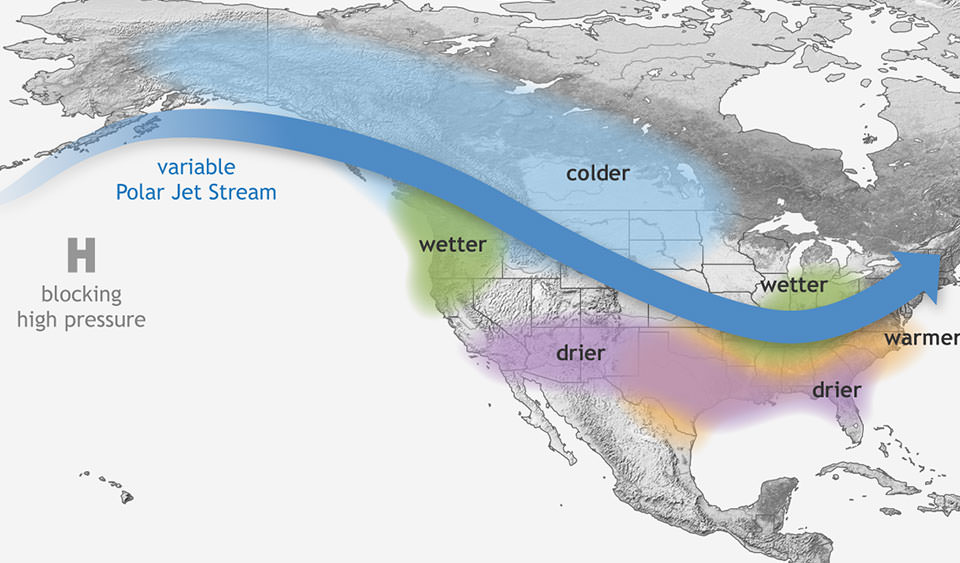
La Niña causes the jet stream to move northward and to weaken over the eastern Pacific. During La Niña winters, the South sees warmer and drier conditions than usual. The North and Canada tend to be wetter and colder. (Photo credit: NOAA)
University of Bern – University of Bern researchers said extreme weather and climate events such as droughts and floods in Europe can be linked to shifts in the jet stream over the Atlantic, based on their reconstruction of the jet stream over the Atlantic and Europe for the last 600 years.
Jet streams are strong winds which occur at a height of approximately 10 kilometres and can reach speeds of up to 500 kilometres per hour. The polar front jet, a strong westerly wind in the temperate zone over the North Atlantic and Western Europe, is of particular importance for the weather in Europe. It steers moisture and weather systems from the Atlantic to Europe, which can lead to flood events. At the same time, shifts in this Atlantic-European jet stream can also lead to droughts in Central Europe.
It is possible that climate change may change the properties of the jet and thus influence the occurrence of extreme weather events. Until recently, not enough data was available to be able to demonstrate this. The degree to which the jet stream fluctuates and how closely it is linked to weather extremes was therefore unknown.
A research group led by the university’s Prof. Stefan Brönnimann at the Oeschger Centre for Climate Research has spent five years collecting, digitizing and evaluating tens of thousands of pieces of data from archives that they gathered dating from the years 1421 to 2023. The data includes early measurement series, historical documents (e.g., on the freezing dates of rivers) as well as natural climate archives such as tree rings and ice cores.
In its study, the research team showed changes in the jet stream are largely random, but nonetheless have far-reaching effects.
“Droughts and floods like those we have experienced in recent years are rare,” Brönnimann explained. “So it is important to examine past events to find out how they relate to changes in the Atlantic-European jet stream.”
The most important findings of the study concern the causes of these changes. Although factors such as volcanic eruptions or the El Niño phenomenon have an influence, it is small. The shifts in the strength, geographical latitude and tilt of the jet stream primarily occur by chance – as a result of natural fluctuations in the atmospheric circulation. Some situations can occur frequently one after the other.
“Certain extreme events such as floods only last a few days, but the weather conditions responsible for them repeat themselves and frequently shape an entire season,” Brönnimann added. “We can also see this in the extreme weather events that occurred in times gone by.
“Although the fluctuations have been pronounced in recent times, they are within the range of changes that we were able to reconstruct for the last 600 years.”
The jet was analyzed with a new, global three-dimensional climate reconstruction. It has a monthly resolution and is based on combining data with climate simulations. A simulation that obeys the laws of physics but has no knowledge of the actual weather is adjusted to the actual observations. Another new feature of the study is the amount of data used, which far exceeds the amounts used in other reconstructions.