La Niña chance at 55 per cent: WMO
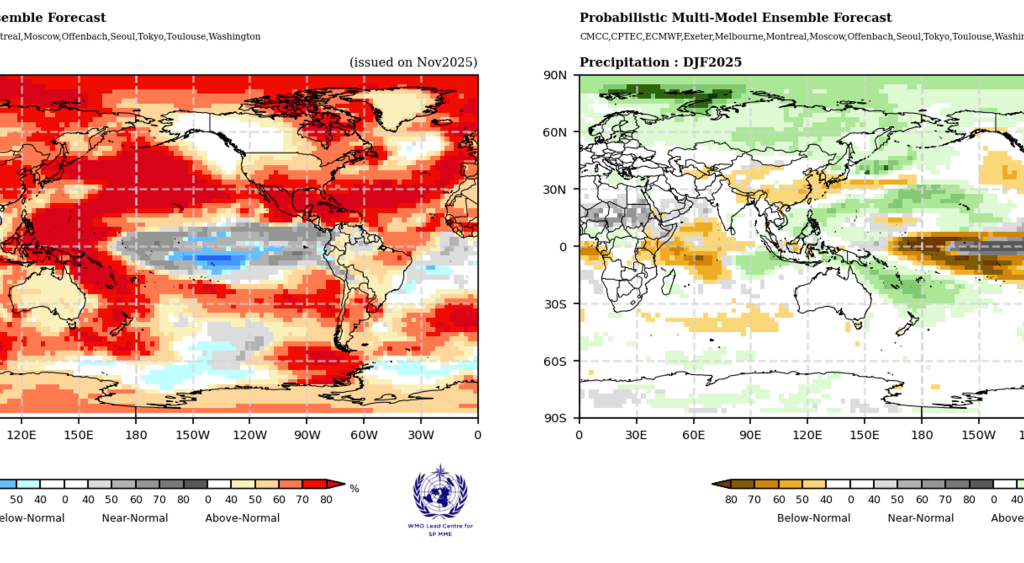
Probabilistic forecasts of surface air temperature and rainfall for the season December-February 2025/26. The tercile category with the highest forecast probability is indicated by shaded areas. The most likely category for below-normal, above-normal, and near-normal is depicted in blue, red, and grey shadings respectively for temperature, and orange, green and grey shadings respectively for rainfall. White areas indicate equal chances for all categories in both cases. The baseline period is 1993–2009. Credit: WMO
World Meteorological Organization – There is a 55 per cent chance of a weak La Niña impacting Earth’s climate and weather patterns until March, said the World Meteorological Organization’s latest update released on Dec. 4.
La Niña refers to the periodic large-scale cooling of the ocean surface temperatures in the central and eastern equatorial Pacific Ocean, which leads to changes in the tropical atmospheric circulation, winds, air pressure and rainfall patterns.
Forecasts from the WMO’s Global Producing Centres for Seasonal Prediction revealed oceanic and atmospheric indicators from last month showed borderline La Niña conditions. There is also a 45 per cent chance that there will be ENSO-neutral conditions from December 2025 to February 2026. However, the WMO said the probability of ENSO-neutral conditions is expected to rise up to 75 per cent in the coming months.
“Seasonal forecasts for El Niño and La Niña are essential planning tools for climate-sensitive sectors like agriculture, energy, health and transport. They are also a key component of WMO’s contribution to support humanitarian operations. This climate intelligence helps us to avert millions of dollars in economic losses and to save countless lives,” said WMO Secretary-General Celeste Saulo.
Despite La Niña’s cooling effect on temperatures in the Pacific Ocean, the update also forecasted above-normal temperatures in much of the Northern Hemisphere and large parts of the Southern Hemisphere.
Much of the Northern Hemisphere will see normal to above-normal amounts of precipitation, while the Southern Hemisphere will mostly see normal amounts. However, parts of the southern United States and equatorial Brazil are set to be drier.