La Niña officially declared by WMO
 WMO – A La Niña weather event has officially developed in the Pacific Ocean and is expected to continue into 2021, affecting temperatures, precipitation, and storm patterns around the world, according to the World Meteorological Organization (WMO)
The global declaration of the La Niña event by the United Nations’ agency will be used by governments to mobilize planning in climate sensitive sectors like agriculture, health, water resources and disaster management.
The latest La Niña is expected to be moderate to strong. The last time there was a strong event was in 2010-2011, followed by a moderate event in 2011-2012.
La Niña refers to the large-scale cooling of the ocean surface temperatures in the central and eastern equatorial Pacific Ocean, coupled with changes in the tropical atmospheric circulation, namely winds, pressure and rainfall. It usually has the opposite impacts on weather and climate as El Niño, which is the warm phase of the so-called El Niño Southern Oscillation (ENSO).
“El Niño and La Niña are major, naturally occurring drivers of the Earth’s climate system. But all naturally occurring climate events now take place in against a background of human-induced climate change which is exacerbating extreme weather and affecting the water cycle,” said WMO Secretary-General Professor Petteri Taalas in the news release.
“La Niña typically has a cooling effect on global temperatures, but this is more than offset by the heat trapped in our atmosphere by greenhouse gases. Therefore, 2020 remains on track to be one of the warmest years on record and 2016-2020 is expected to be the warmest five-year period on record,” said Professor Taalas. “La Niña years now are warmer even than years with strong El Niño events of the past.”
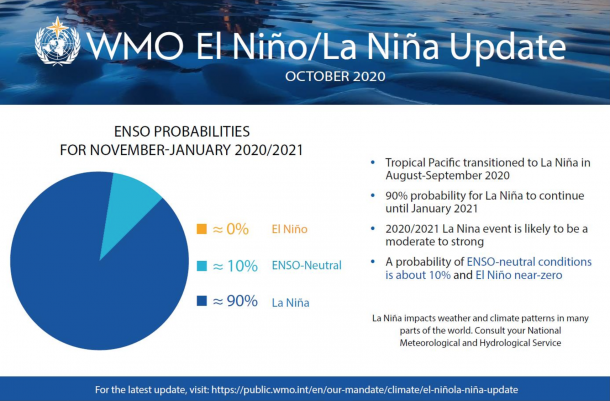
WMO’s new ENSO Update states there is a high likelihood (90%) of tropical Pacific sea surface temperatures remaining at La Niña levels through the end of 2020, and maybe through the first quarter of 2021 (55%). This follows more than a year of neutral ENSO conditions (i.e., neither El Niño nor La Niña). The Update is based on forecasts from WMO Global Producing Centres of Long-Range Forecasts and expert interpretation.
El Niño and La Niña are not the only factors that drive global and regional climate patterns, said the WMO. No two La Niña or El Niño events are the same, and their effects on regional climates can vary depending on the time of year and other factors. Therefore, decision makers should always monitor latest seasonal forecasts for the most up to date information.
For this reason, WMO is now adding to the existing portfolio of seasonal information provided through the National and Regional Climate Outlook Forums and has increased the frequency of the Global Seasonal Climate Update (GSCU) from quarterly to monthly.
In addition to El Niño and La Niña, the GSCU incorporates influences of other climate drivers, such as the North Atlantic Oscillation, the Indian Ocean Dipole, to assess their likely effects on regional surface temperature and precipitation patterns and as such used to underpin much of the seasonal discussions with the United Nations and other partners.