La Nina to influence U.S. winter: NOAA
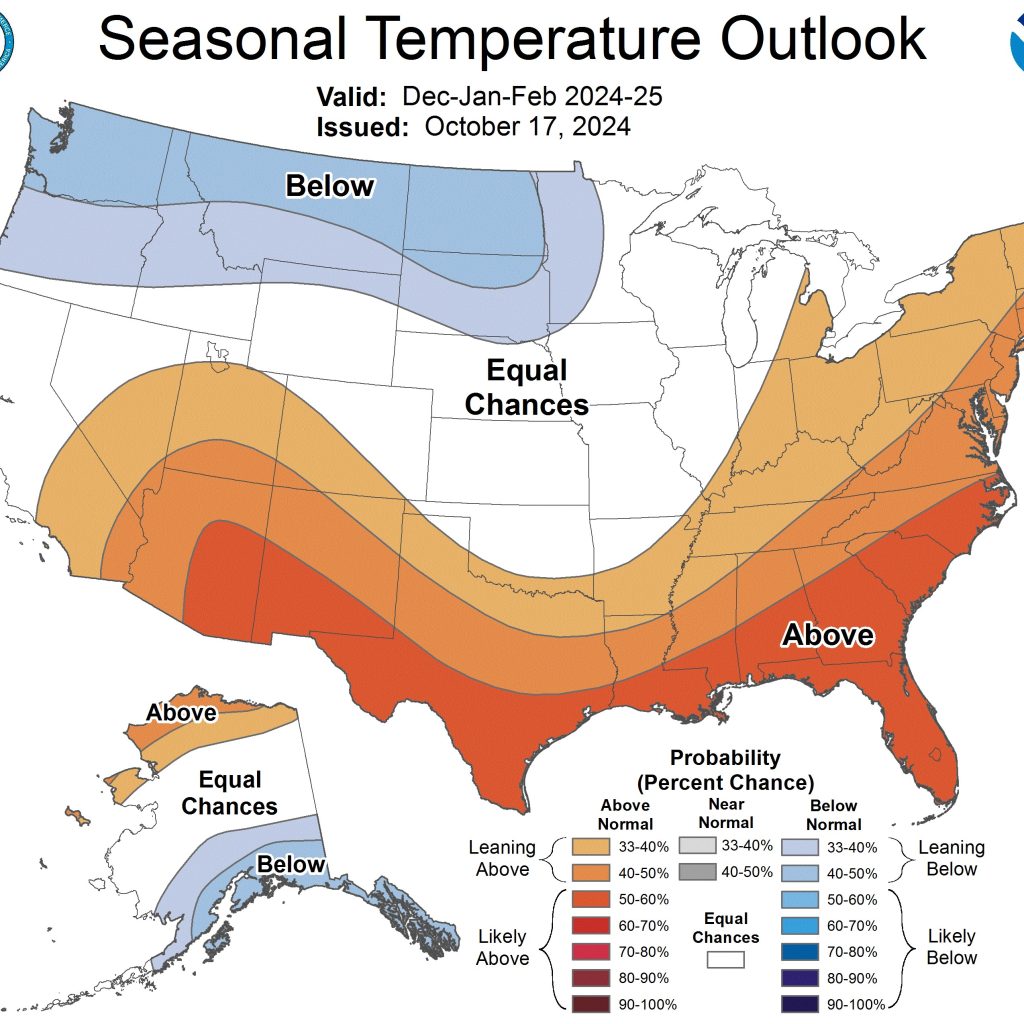
The 2024-2025 U.S. Winter Outlook map for temperature shows the greatest chances for cooler-than-average conditions in the Pacific Northwest of the U.S. (Image credit: NOAA)
National Oceanic and Atmospheric Administration – Most of the United States is expected to be influenced by a slowly-developing La Nina through the upcoming winter, according to an outlook from the NOAA’s Climate Prediction Center released Oct. 17.
NOAA predicts wetter-than-average conditions for the entire northern tier of the continental U.S., particularly in the Pacific Northwest and the Great Lakes region, along with northern and western Alaska. Meanwhile, drier-than-average conditions are expected from the Four Corners region of the Southwest to the Southeast, Gulf Coast and lower mid-Atlantic states.
“This winter, an emerging La Nina is anticipated to influence the upcoming winter patterns, especially our precipitation predictions,” said Jon Gottschalck, chief of the Operational Prediction Branch of the Climate Prediction Center.
La Nina conditions are expected to develop later this fall and typically lead to a more northerly storm track during the winter months, leaving the southern tier of the country warmer and drier. As a result, NOAA forecasters, in collaboration with the National Integrated Drought Information System (NIDIS), expect drought conditions to persist and worsen across the central and southern Plains of the U.S.
“Unfortunately, after a brief period in the spring of 2024 with minimal drought conditions across the country, more than a quarter of the land mass in the continental U.S. is currently in at least a moderate drought,” said Brad Pugh, operational drought lead with NOAA’s Climate Prediction Center. “And the winter precipitation outlook does not bode well for widespread relief.”
Warmer-than-average temperatures are favored from the southern tier of the U.S. to the eastern Great Lakes, eastern seaboard, New England and northern Alaska. These probabilities are strongest along the Gulf Coast and for most of Texas.
Below-average temperatures are most likely in southern Alaska, with below-average temperatures slightly favored from the Pacific Northwest to the northern High Plains.
The remaining areas have equal chances of below-, near-, or above-average seasonal mean temperatures.
Wetter-than-average conditions are most likely in the Great Lakes states, and above-average precipitation is also favored in northern and western Alaska, the Pacific Northwest and across the northern tier of the U.S. These probabilities are strongest in portions of Ohio, Indiana and Kentucky.
The greatest likelihood for drier-than-average conditions are in states bordering the Gulf of Mexico, as well as in Texas and southern New Mexico.
Much of California, the central Plains states and the I-95 corridor from Boston to Washington, D.C., have equal chances of below-average, near-average or above-average seasonal total precipitation.
Widespread moderate to extreme drought continues across much of the Great Plains and in portions of the Rocky Mountains, especially farther south.
Drought conditions are expected to improve or end in the Ohio River Valley, the Great Lakes region and portions of the northwestern U.S., including eastern Washington and Oregon and northern and central Idaho.
Drought conditions are expected to persist across the Great Plains and is likely to develop or worsen across portions of the Southwest and Gulf Coast.