
La Niña peaks, but impact still felt
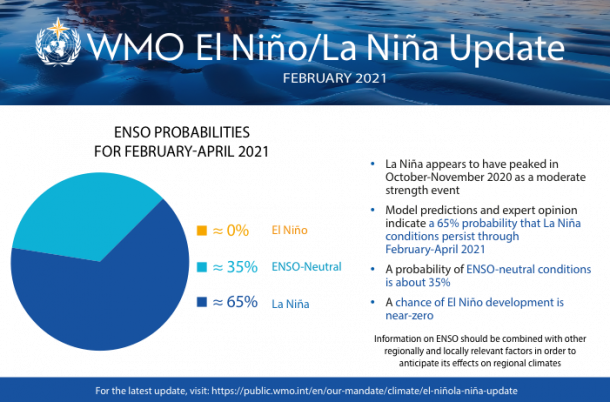
 WMO – The 2020-2021 La Niña event has passed its peak, according to a new update from the World Meteorological Organization (WMO), although impacts on temperatures, precipitation and storm patterns are expected to continue.
La Niña, which refers to the large-scale cooling of ocean surface temperatures in the central and eastern equatorial Pacific Ocean, appears to have peaked in October-November as a moderate strength event. There is a 65% likelihood that it will persist during February-April, with a 70% chance that the tropical Pacific will return to ENSO-neutral conditions by the April-June 2021 season, according to WMO’s El Niño-La Niña Update.
La Niña usually has the opposite impacts on weather and climate as El Niño, which is the warm phase of the so-called El Niño Southern Oscillation (ENSO).
“El Niño and La Niña are major drivers of the Earth’s climate system. But all naturally occurring climate events now take place in the context of human-induced climate change, which is increasing global temperatures, exacerbating extreme weather, impacting seasonal rainfall patterns and complicating disaster prevention and management,” said WMO Secretary-General Petteri Taalas.
“Thanks to our ability to predict La Niño and El Niño events in advance, the WMO community has been able to strengthen its support to governments, the United Nations, and stakeholders in climate sensitive sectors to mobilize preparations and save lives,” he said.
La Niña has a temporary global cooling effect. But this was not enough to prevent 2020 from being one of the three warmest years on record. La Niña and El Niño effects on average global temperature are typically strongest in the second year of the event, but it remains to be seen to what extent the current La Niña will influence global temperatures in 2021, said the WMO.
Global Seasonal Climate Update
El Niño and La Niña are major, but not the only, climate drivers. WMO’s Global Seasonal Climate Update (GSCU) incorporates influences of all other major climate drivers such as the North Atlantic Oscillation, the Arctic Oscillation, the Indian Ocean Dipole and other teleconnection patterns.
Other than in a few small areas, above-normal land temperatures are expected to dominate everywhere for February-April 2021, according to the latest GSCU, based on forecasts from WMO Global Producing Centers of Long-Range Forecasts.
The highest probabilities of above-normal temperatures occur in western, central and eastern Asia and over the southern half of North America. Above-normal temperatures are also likely over much of the northern high latitudes (except over north-western North America), southern, central and eastern parts of South America, and equatorial and northern regions of Africa.
Below-normal temperatures are more likely for northern South America.