Low to moderate risk of flooding in Manitoba
But dependent on weather conditions heading to spring
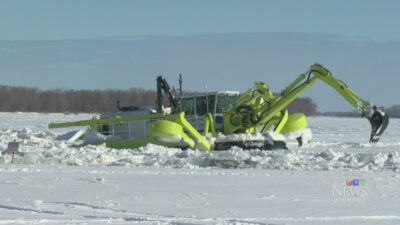
An amphibex lowers its backhoe so it can pull itself on the ice, thereby breaking it. This amphibex is working on the Red River in the RM of St. Clements north of Winnipeg, Man. (RM of St. Clements)
WeatherFarm – There will likely be a low to moderate risk of spring flooding in Manitoba, according to the province’s Hydrologic Forecast Centre.
In the Centre’s first report of 2023, it projected moderate risks along the Red, Assiniboine, Fisher and Icelandic Rivers, while the chances of flooding are expected to be lower along the Souris, Roseau, Rat and Pembina Rivers. However, the Centre stressed everything is dependent on weather conditions heading towards the spring melt.
Environment and Climate Change Canada (ECCC) issued its three-month outlook on Feb. 28, with expectations of normal precipitation levels and temperatures throughout southern Manitoba.
Nevertheless, the Centre said it’s very likely the Red River Floodway and the Portage Diversion on the Assiniboine River will have to be used to divert excess water around the Winnipeg area as well as reduce the chances of ice jams. Already ice cutting and breaking operations are underway on the Red River north of the city, to be followed by work further north on the Icelandic River later this month. The centre said it does not see a need for such work in the Portage Diversion due to low water levels.
The Centre reported that snow water content is 30 to 80 millimeters across most of southern Manitoba. The content in the Interlake region is 30 to 60 mm, while the heaviest amounts are in the Riding Mountain and Duck Mountain parks, as well as the Porcupine Mountains, with up to 167 mm.
Based on that, higher water levels are projected for Dauphin Lake and Lake St. Martin, while normal springtime levels are expected for Lake Winnipeg and Lake Manitoba.
As for soil frost depth, while it varies across the province the Centre said it’s generally normal to shallower, thereby providing the opportunity for more water to be absorbed.
The Centre will release its second report at the end of March.