
March 2024 warmest on record: NOAA
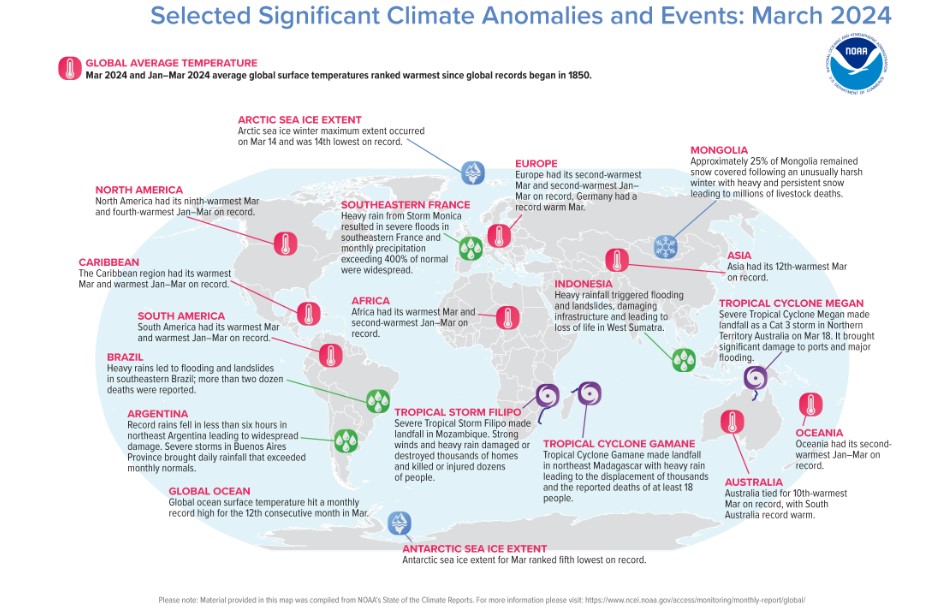
An annotated map of the world plotted with March 2024's most significant climate events. (Credit: NOAA/NCEI)
NOAA – Earth added another remarkably warm month to the year so far, with March 2024 ranking as the warmest March in the planet’s climate record, according to the National Oceanic and Atmospheric Administration (NOAA).
Last month also continued the world’s streak of record-breaking warm months — 10 in a row — according to scientists and data from NOAA’s National Centers for Environmental Information (NCEI).
The average global land and ocean-surface temperature for March was 1.35 degrees Celsius above the 20th-century average of 12.7 C, ranking as the warmest March in the 175-year global climate record. March 2024 was also the 10th-consecutive month of record-high global temperatures.
Looking at the continents, Africa and South America had their warmest March on record while Europe saw its second warmest. In contrast, parts of western North America, central Asia and western Australia were cooler than average last month.
The 2024 year-to-date (YTD) global surface temperature was the warmest such period on record at 1.35 C above the 20th-century average. South America had its warmest YTD period, while Africa, Europe and Oceania had their second warmest.
According to NCEI’s Global Annual Temperature Outlook, there is a 55 per cent chance that 2024 will rank as the warmest year on record and a 99 per cent chance that it will rank in the top five warmest.
Globally, polar sea ice coverage ranked as the eighth-smallest extent (coverage) on record. Arctic sea ice extent was slightly below average (by 155,399 square kilometres), while Antarctic sea ice extent was significantly below average (by 906,496 sq. km), ranking as the fifth-smallest coverage on record.
Four named storms swirled across the globe in March, ranking below the 1991 to 2020 average of six. The only major storm was Severe Tropical Cyclone Neville, which brought high surf to coastal northwestern Australia. There were two other storms in the South Indian Ocean that impacted Africa — Filipo, which brought strong winds and torrential rains to Mozambique; and Gamane, which brought strong winds and heavy rains to Madagascar.