
May 2024 warmest on record
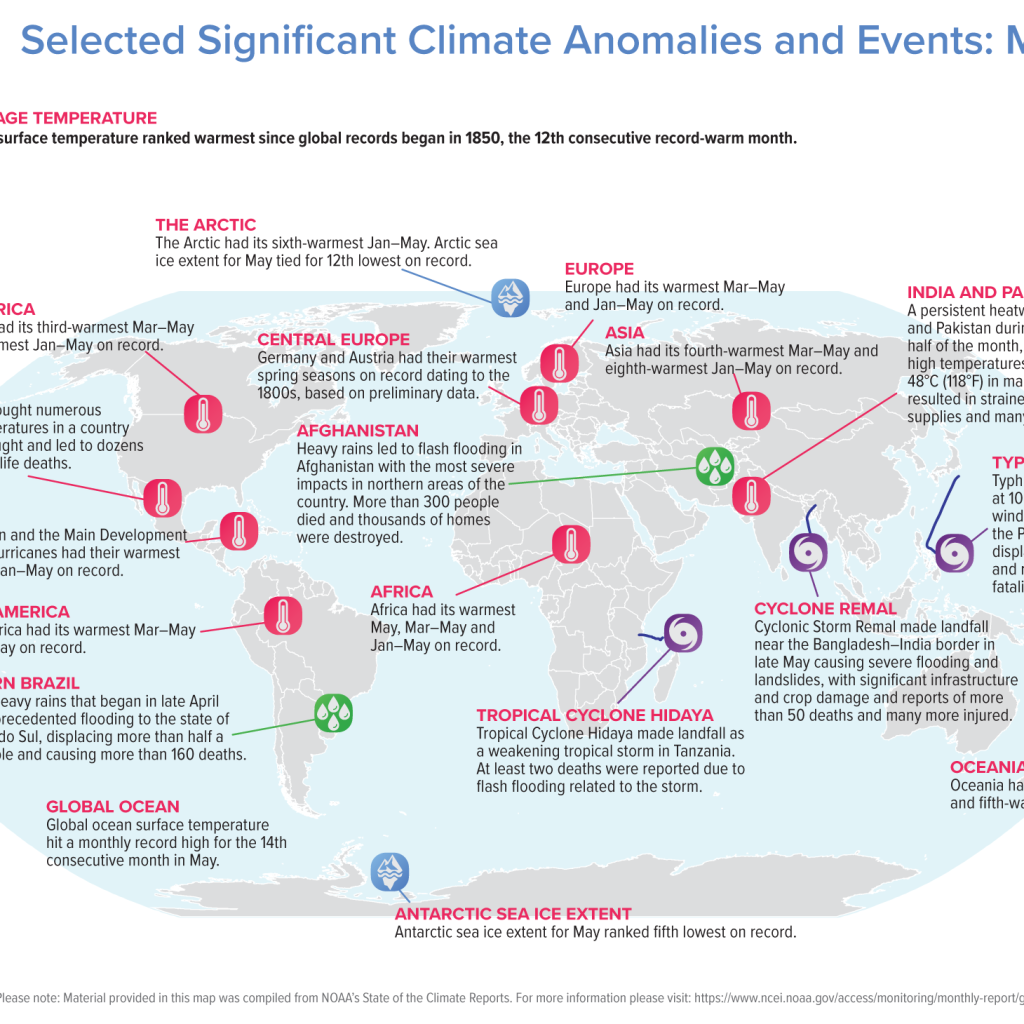
An annotated map of the world plotted with the most significant climate events of May 2024. Image credit: NOAA/NCEI.
NOAA – Last month marked a full year of record-high global temperatures, with May 2024 ranking as the warmest May on record, according to the National Oceanic and Atmospheric Administration (NOAA).
Earth’s ocean temperatures also set a record high for the 14th month in a row, according to data and scientists from NOAA’s National Centers for Environmental Information (NCEI).
The average global May temperature was 1.18 degrees Celsius above the 20th-century average of 14.8 C, ranking as the warmest May in NOAA’s 175-year global record. May 2024 marked the 12th-consecutive month of record-high temperatures for the planet.
Looking at the world’s land masses, temperatures were above average across most of the globe except for western North America, Greenland, southern South America, western Russia and parts of eastern Antarctica. Africa had its warmest May on record.
May 2024 was the 14th-consecutive month of record-warm ocean temperatures, a streak that has been running since April 2023. Looking regionally, sea surface temperatures were above average over most areas (and record warm over the tropical Atlantic Ocean), while parts of the Southern, southeastern Pacific and southern Indian Ocean basins were below average.
The March to May period — defined as the Northern Hemisphere’s meteorological spring and the Southern Hemisphere’s meteorological autumn — was the warmest on record at 1.29 C above average.
The year-to-date (YTD, January through May 2024) global surface temperature ranked as the warmest such period on record, 1.32 C above average. Africa, Europe and South America each had their warmest such YTD period, with North America ranking second warmest.
According to NCEI’s Global Annual Temperature Rankings Outlook, there is a 50 per cent chance that 2024 will rank as the warmest year on record and a 100 per cent chance that it will rank in the top five.
Global sea ice extent (coverage) was the seventh smallest in the 46-year record at 22.04 million square kilometres, which was 1.19 million sq. km below the 1991 to 2020 average. Arctic sea ice extent was below average by 155,400 sq. km, and Antarctic sea ice extent was below average by 1.01 million sq. km.
Five named storms occurred across the globe in May, which was above the 1991 to 2020 average of four. Two of these reached tropical cyclone strength: Tropical Cyclone Hidaya in the South Indian Ocean basin, which brought gusty winds and rain to coastal Tanzania, and Typhoon Ewiniar, which caused flooding and wind damage in the Philippines and Japan.