
May 2025 second-warmest on record: NOAA
ENSO-neutral expected for this summer
Credit: NOAA/NCEI
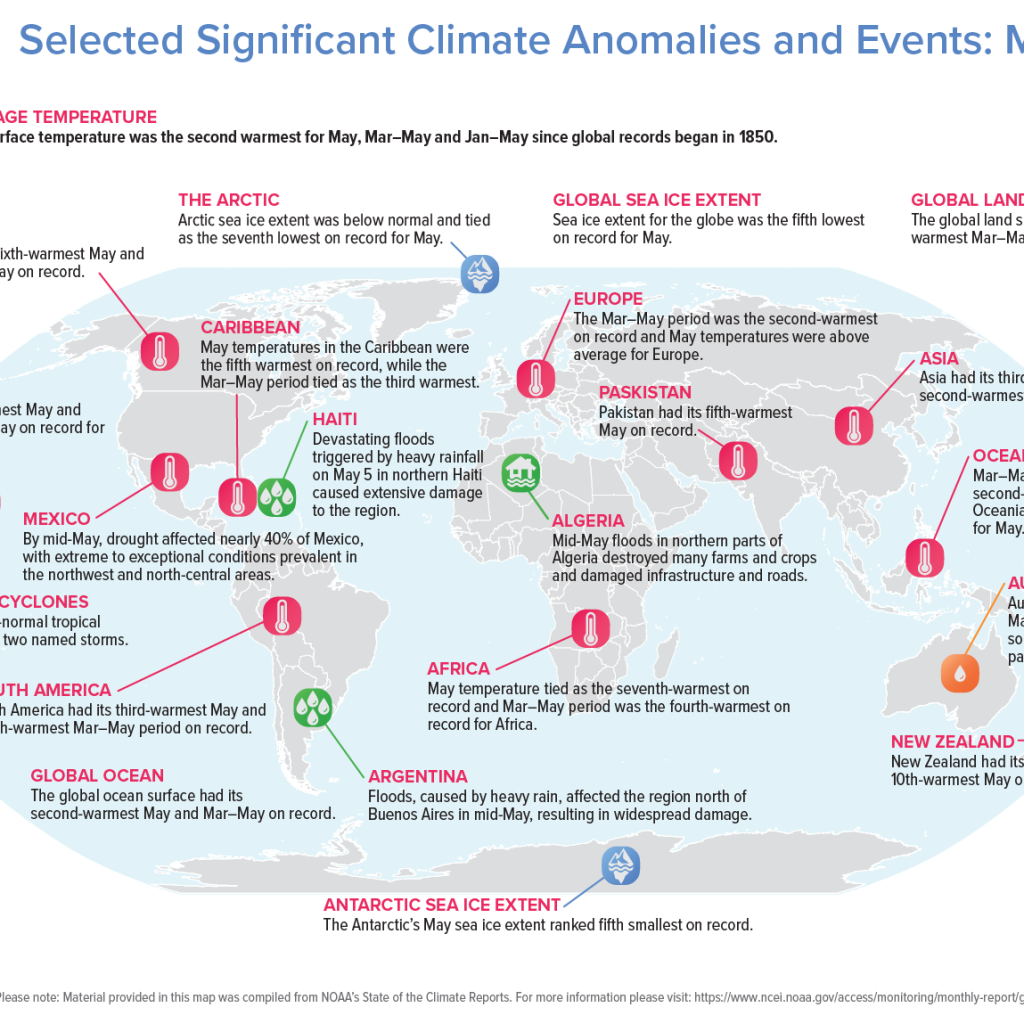
National Oceanic and Atmospheric Administration – May 2025 was the second-warmest May on record according to data from the NOAA.
The May 2025 global surface temperature was 1.10 degrees Celsius higher than the 20th-century average. This was the second-warmest May since NOAA’s records began in 1850. Only May of 2024 was warmer, with a temperature 0.08 C higher than 2025.
The May 2025 global surface temperature was 0.10 C higher than in 2020, which currently holds the third-warmest May on record. May 2020 notably marked the first time a May temperature reached 1.0 C above the 20th-century average. The ten warmest Mays on record have all occurred since 2014. May 2025 also marked the 49th consecutive May with above-average global temperatures.
The global land-only surface temperature for May 2025 was also the second-highest in the 176-year record, with a temperature 1.61 C higher than the 20th-century average. The global ocean-only May surface temperature was 0.88 C higher than average — also the second-highest for May in the 176-year record.
El Niño-Southern Oscillation (ENSO), a weather phenomenon that can affect global weather patterns and influence global temperatures, persisted in a neutral phase (meaning neither El Niño nor La Niña were present) during May 2025. According to NOAA’s Climate Prediction Center, ENSO-neutral is likely to continue through the Northern Hemisphere summer.
May temperatures were much warmer than average across much of the globe, in particular across most ocean areas and parts of every continent. Temperatures were most notable in northern North America, the central and southern parts of South America, the British Isles and surrounding ocean, northern and southwestern Asia, and across much of Antarctica and the Arctic region, where temperature departures were +1.5 C or higher.
Despite the unusual warmth across much of the globe, record-warm temperatures were limited to parts of the Arctic region, the British Isles and surrounding ocean, southwestern Asia, across parts of the western Indian Ocean, the western Pacific Ocean, and a small area in Mexico. Overall, approximately seven per cent of the world’s surfaces had a record-high May temperature. This percentage is the second-highest on record for May, following the all-time record of 15 per cent set in May 2024.
Cooler-than-average May temperatures were observed across parts of the northern Atlantic Ocean and eastern and southeastern Pacific Ocean.
While the Arctic had its fourth-warmest May on record, North America had its sixth-warmest May.