Millions face hunger as drought grips Ethiopia, Kenya and Somalia
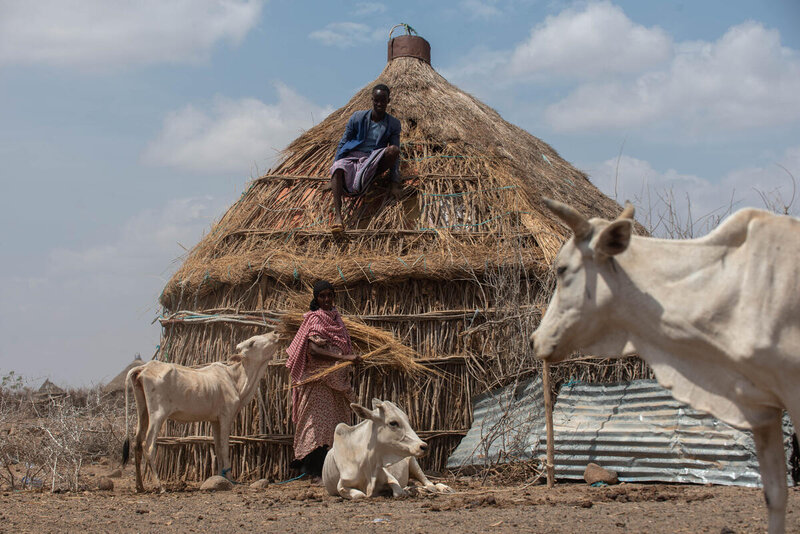
Haha Abdi, 50 a mother of seven and resident of Higlo Kebele in Adadle wereda of Somali region of Ethiopia in the place where many families are to reap the benefits of a climate risk microinsurance scheme, stile fighting to survive the drought by feeding the livestock a grass roof cover of their houses. Ethiopia is experiencing prolonged drought with three consecutive poor rainy seasons, the first time in four decades; three consecutive rainy seasons have failed since late 2020. There are indications that the next rainy season in March/April 2022 may also be well below normal. The intense and ongoing drought will cause significant food and income loss, worsening food insecurity through mid-2022. Crisis (IPC Phase 3) outcomes are expected in southern and south-eastern pastoral areas in the coming months, with some households facing Emergency (IPC Phase 4) levels of hunger. According to the Somali Region Drought Response Plan December 2021: • up to 3.3 million people are likely to require food assistance in the next three months. • 2.2 million people are facing water shortages and need urgent water trucking. • 173,000 children under 5 years of age and pregnant and lactating women are malnourished. • 260,000 livestock have died, signalling growing stresses and vulnerability to human populations. These challenges are exacerbating longer-term difficulties linked to COVID-19, inflation, desert locust invasions, poor infrastructure, and drought. • During a nutritional screening conducted in the Somali Region in December 2021, 22 percent of children and a third of pregnant and breastfeeding women were found to be wasted. All zones exceeded the emergency Global Acute Malnutrition (GAM) threshold of 15 percent, and eight of 11 zones having higher than 20 percent prevalence. Response WFP is scaling up its support to reach 2.7 million beneficiaries in the Somali Region with emergency food assistance an
A family feed their cows straw plucked from the roof of their home in Adadle in the Somali region of Ethiopia. Photo: WFP/Michael Tewelde
World Food Programme (WFP) – More than 13 million people across Ethiopia, Kenya, and Somalia face severe hunger as the driest conditions in decades cause severe drought across the Horn of Africa, the United Nations’ World Food Programme (WFP) warned on Feb. 8.
Crop failures and an abnormally high rate of livestock deaths are dealing a crushing blow to whole communities’ ability to grow, sell and consume nutritious foods, after three consecutive failed rainy seasons.
“Harvests are ruined, livestock are dying and families are bearing the consequences of increasingly frequent climate extremes,” stated Michael Dunford, WFP’s Regional Director for Eastern Africa.
“Droughts in the Horn of Africa are becoming more frequent and severe and are one of the key drivers of hunger across the region, devastating livelihoods and forcing families from their homes. These impacts reinforce the need for immediate humanitarian action and the importance of building the resilience of communities for the future.”
The lack of rains is also driving displacement as families are forced to move in search of water and pasture, leading to intercommunal conflicts.
“It’s shocking when you meet people and you hear their personal stories,” added Dunford during a video call from Nairobi. “If you meet a pastoralist who’s lost all their animals, it’s devastating.”
“Certainly, because of the climate changing, the situation is becoming worse,” he continued. “We really need to be investing at scale using all of the techniques that the WFP and others have developed.
“We also need to continue to build on the anticipatory actions – early warning systems, access to financing when triggers are heard, access to different types of crop or livestock insurance… there’s so much that we are doing that is cushioning the blow but [there have been] three years of insufficient rains.”
The drought has hit pastoral and farmer populations across southern Ethiopia, northern Kenya and south-central Somalia. Impacts are compounded by increases in staple food prices, inflation and low demand for agricultural labour, further challenging families’ ability to buy food. Malnutrition rates also remain high across the region and could worsen if no immediate action is taken.
“The statistics that I am seeing suggest that this is the driest this region has been in 40 years,” said Dunford. Does it translate to the worst drought in 40 years? “Well, it depends how you want to measure. In 2011 there was a drought that killed 250,000 people in Somalia. We’re not there yet.”
“But don’t get me wrong, the situation is dire. I met climate evacuees living in camps for internally displaced people for over a year now because they lost all their animals. They have nothing left. And the only way they can meet the basic needs of their families is by coming into the villages where they are now receiving WFP support,” he said.
So what of the investments that WFP and others have made in the region over the course of the last 10 years? “By improving the ability of the populations to manage such climactic shocks, the needs are reduced and the impact has been lessened or delayed,” said Dunford.
Chief among his concerns now is the threat of reduced rations. “What does it mean for WFP not to be able to provide a family with the minimum monthly entitlement?” he asks.
“[The money is] primarily for emergency response, with a proportion to continue to build capacities of communities and individuals to meet their own needs,” explained Dunford. “What we can’t have is people adopting negative coping measures, either losing all their livestock or alternatively having to sell it, because once the drought is over, once the rains ultimately break, they won’t have anything and they’ll still be dependent.”
Action is required immediately and at scale. “WFP has a long history of building resilience across the region. We’ve transformed vast swathes of territory into land that is suitable for agricultural [activities],” says Dunford. “The key for WFP is always the scale we operate at, particularly in close partnership and collaboration with the Governments at the central and regional levels and then directly with the communities and families.”