
Monsoon forecast model mostly accurate, but room for improvement
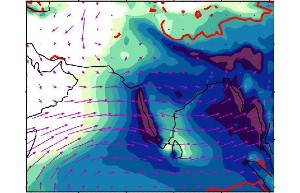
 University of Reading – Seasonal monsoon rains are key to agriculture in India, with early forecasts helpful in reducing crop losses. New analysis of the European Centre for Medium-range Weather Forecasts (ECMWF) shows that the model used by the ECMWF is accurate a month in advance of the monsoon onset, although actual rainfall amounts were overestimated in some areas and underestimated in others.
Researchers at the University of Reading in England and the ECMWF led the first ever in-depth study into how accurately ECMWF’s latest long-term global weather forecasting system can predict when the summer monsoon will start, and how much rainfall it will bring.
The research found the model provided accurate forecasts a month in advance for the timing of the monsoon in India’s major agricultural regions. Providing this information to farmers could help them prepare earlier for unexpected heavy rainfall or extended dry periods, both of which regularly destroy crops in India.
“The Indian monsoon brings around 80 per cent of India’s annual rainfall, so even small variations in the timing of its arrival can have a huge impact on agriculture,” said Dr Amulya Chevuturi, a monsoon researcher at the University of Reading and lead author of the study. “Accurately predicting these year-to-year variations is challenging, but could be the difference between prosperity or poverty for many families,” she added.
“The forecasting accuracy we identified in India’s main agricultural regions provides a clear opportunity for this system to make a positive difference to people’s lives,” said Chevuturi. “A month’s warning of a drought or deluge is valuable time to understand the likely impact on water availability and for farmers to make provisions to reduce the threat to food supplies.”
The Indian monsoon season starts around June 1 every year, beginning in southwest India before spreading across the whole subcontinent.
Scientists looked at 36 years’ worth of monsoon data to evaluate for the first time the effectiveness of the ECMWF’s latest seasonal forecasting system – SEAS5 – in predicting how the Indian monsoon would differ from the long-term average.
The team compared forecasts from May 1 each year from 1981-2016 with actual observations of the monsoons that followed.
The study, published in Climate Dynamics, found the forecasts were accurate for the large-scale processes, like temperature and winds, that drive the monsoon rainfall across India. The study also found that SEAS5 was good at predicting early or late monsoon arrival over the important agricultural regions along the river Ganges plains and the eastern and western coasts of India.
It also identified deficiencies in the system that could pave the way for model improvements, potentially providing more detailed and accurate seasonal long-term monsoon forecasts.
The study showed the forecasts tended to overestimate rainfall over the mountainous Western Ghats and Himalayan regions, and underestimated rainfall along the plains of the river Ganges in the north of the country, and its delta at the Bay of Bengal.
However, the forecasts were correct for the monsoon rainfall pattern across India, making them useful for planning purposes.