
More effective flood prediction method proposed
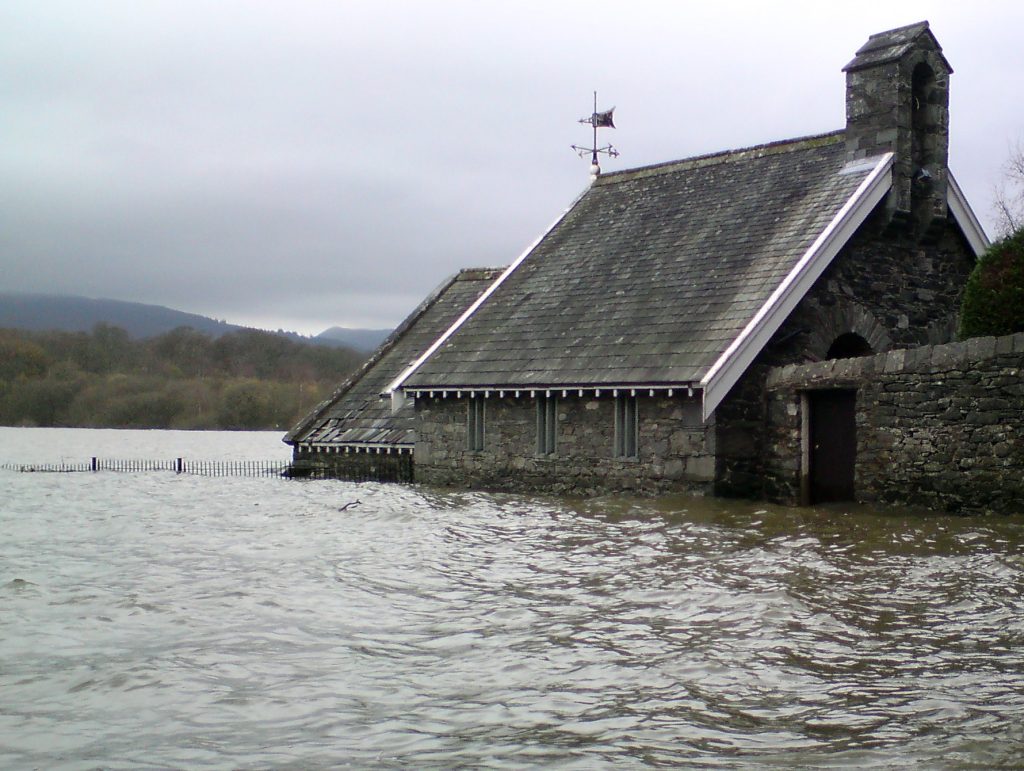
Flooded lake house, Keswick, Cumbria, UK (Photo by Gavin Lynn)
Xi’an Jiaotong-Liverpool University – Existing flood prediction models tracking historical patterns no longer provide enough accuracy giving shifting climate conditions, according to a new study proposing a more effective alternative method to flood forecasting.
More of us are vulnerable to the effects of flooding than ever before due to changes in climate, land use, infrastructure and population growth in recent decades. It is, therefore, crucial to accurately predict flood frequency and severity to reduce physical and economic losses.
Conventional analysis of flood frequency assumes that flooding follows historic patterns, and the methods used often do not take into account changing conditions such as climate change, river regulation, and land cover variation. This creates a higher risk of underestimating the frequency and severity of floods and designing less resilient infrastructure.
In a recent study published in the Journal of Hydrology, researchers from Xi’an Jiaotong-Liverpool University (XJTLU), China; Chung-Ang University, Korea; and the University of Liverpool, United Kingdom, proposed that an alternative method is more appropriate for analysing flood frequency in a changing environment.
The team of researchers propose a model that is a type of nonstationary flood frequency analysis. Nonstationary models provide more reliable estimations for water-related structures and flood prevention measures as they take into account variations of factors influencing flood frequency.
Despite nonstationary flood frequency analysis now being a hot research topic, there is a lack of consensus on the most appropriate methods. The existing models are either too complicated or too expensive for engineers or hydrologists to implement in practice.
Mengzhu Chen, the first author of the paper, is a PhD student at XJTLU’s Department of Civil Engineering. Back in 2021, she published a study that used a different model of nonstationary flood frequency across the UK. However, she found there were limitations in applying this approach to practices like engineering design and hydraulic structure design.
“We were unable to express the model as a simple mathematical formula which made it difficult to interpret and calculate. Therefore, we wanted to find a more suitable model,” Chen said.
To assess and compare different modelling techniques in the current study, the researchers analysed historical flood data from 161 catchments across the UK. These areas, also known as watersheds or drainage basins, have natural boundaries such as ridges, hills or mountains, and all surface water drains to a common channel to form rivers or creeks.
They found that the ‘fractional polynomial-based regression’ model is the most flexible, effective, and user-friendly among all the models. This method is an emerging tool in certain applied research areas like medical statistics and clinical research but is currently used very little in the hydrology field.